|
|
|
|
|
 |
|
|
|
|
|
|
|
|
Cranston Fine Arts  Postcards Postcards  New for March 2020 New for March 2020 |
[UP] - 2024 Postcard releases - New for August 2023 - New for January 2023 - New for June 2022 - New for May 2022 - NEW 2026 Postcard releases - New for 2021 - New for October 2020 - New for March 2020 - New for 2019 |
New postcards published by Cranston Fine Arts in March 2020.
| Navigation | |
| Page 1 of 10 | Page 1 .. Next |
|
|
|
|
|
|
|
|
|
|
|
|
|
|
|
|
|
|
|
|
|
| Navigation | |
| Page 1 of 10 | Page 1 .. Next |
| Text for the above items : |
Hurricane Mk.IIC by Ivan Berryman. (PC) Messerschmitt Bf.110G4b/R3 of 7 Staffel, III/Natchjagdgeschwader 4, Autumn 1943. |
The 79th Victory by Ivan Berryman. (PC) For Manfred von Richthofen, the air battle in the skies west of Amiens on 20th April 1918 was to yield a final two victories to add to the seventy eight with which he was already credited. But these were to be his last, the Red Baron finally succumbing the following day. Just moments before Second Lieutenant David Lewis' 3 Sqn Sopwith Camel fell to the German's guns (the young pilot surviving to tell his story of being the Red Baron's final victim), Major Richard Raymond-Barker was not so lucky, his aircraft burning furiously until it hit the ground in a fireball near the Forest of Hamel. |
Gunner's Moon by Ivan Berryman. (PC) On the night of 7th-8th June 1944, a Lancaster of No.207 Sqn piloted by Wing Commander John Grey was part of a force of 112 bombers and 10 Mosquitoes sent to attack a tank storage park near Cerisy-la-Foret. With the D-Day landings just 48 hours old, it was considered too risky to leave the tank park intact, should the Germans try to launch a counter thrust from this position, just 20 miles from the French coast near Bayeux. Shortly after crossing the coast, Greys aircraft was attacked by a JU.88 and both the mid upper gunner Sutherland and tail gunner McIntosh opened fire on their pursuer and sent it down in flames. No sooner had they recovered from this fright when a second JU.88 closed in on them. Again, both gunners combined their fire and destroyed the enemy aircraft in mid air. Grey pressed on to the target where their bombs fell on the enemy tank depot, also destroying some fuel dumps and an important road junction. Returning to the French coast to begin their journey home, they were attacked yet again, this time by a Messerschmitt Bf 110. With machine-like precision, McIntosh and Sutherland opened fire together, claiming their third victim in a single night. For this extraordinary feat, both gunners were awarded the DFC. |
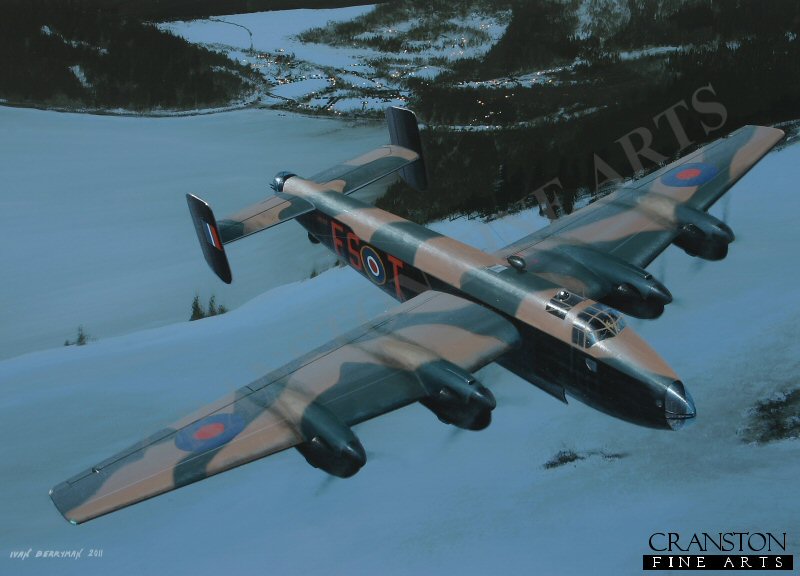
Operation Ebensburg by Ivan Berryman. (PC) Sunday 8th April 1945. Halifax B.II Series 1 (Special) JP254 of 148 Special Duties Squadron, RAF piloted by Pilot officer Bill Leckie is depicted approaching the drop zone near to the Alt Aussee salt mine in the Austrian Alps to drop four SOE agents and their equipment whose mission it was to secure and protect 6,755 items of the world's greatest works of art that had been looted and stored by the Germans as they swept across Europe. With the allied forces closing in, the Germans had planned to blow up the entire store to prevent the artworks from falling into the hands of the liberators. Once on the ground, the four agents linked up with local resistance fighters and the mine and its valuable contents were eventually secured, the explosives made safe and the entire cache taken into the safe keeping of the 80th US Infantry Division as the German occupation of Europe crumbled. |
In the Thick of Battle by Chris Collingwood. (PC) Lieutenant of the Royal Navy commands marines and crew during a sea battle with the French during the battle of Cape St Vincent. |
Kiwis at Dallachy - Tribute to No.489 Squadron by Ivan Berryman. (PC) The formation of six New Zealand squadrons within the RAF in the early part of WW2 acknowledged the contribution and commitment of the Commonwealth to the campaign against the Nazi invasion of Europe. Among these was 489 Sqn, based at Dallachy in Scotland, whose Beaufighter Mk Xs flew missions against Axis shipping in the North Sea as well as other missions along the Scandinavian coast. Here, two 489 Sqn Beaufighters run up their engines prior to a sortie in the Winter of 1943/44. |
Adversaries by Ivan Berryman. (PC) No one knows for certain whether the two great fighter aces Douglas Bader and Adolf Galland actually fought each other in a one-on-one combat, but it is thought highly likely that they did as the famous Tangmere Wing led by Bader regularly found itself dueling with the Bf.109s of JG.26 led by Galland. Their great rivalry came to an end in August 1941 when Bader was shot down over St Omer, but these two heroes were to become close friends after the war, each having the utmost respect for the other. |
Last But One by Ivan Berryman. (PC) In the skies just west of Amiens on 20th April 1918, the celebrated German ace, Manfred von Richthofen, the Red Baron, flying his famous all-red Fokker DR.1 Triplane 425/17 and accompanied by other DR.1s of his notorious Flying Circus, encountered Sopwith Camels of No.3 and No.201 Squadrons and a fierce aerial battle ensued. Two Sopwith Camels were to fall to the Red Baron's guns that day, the first of them being Major Richard Raymond-Barker, shown here flicking his aircraft to the right to avoid the German's fire. Raymond-Barker was almost immediately shot down, his burning aircraft being consumed by fire on impact. Just minutes later, Second Lieutenant David Lewis was caught and despatched, these two British scouts being the last ever victims of Baron von Richthofen. |
1st Regiment French Light Infantry at Waterloo by Brian Palmer. (PC) No text for this item |
222 Sqn Meteors over the Forth Bridge by Ivan Berryman. (PC) Three Gloster Meteor F.Mk4s of 222 'Natal' Squadron are depicted on a training sortie over the Forth Bridge in the early 1950s. |
Shell House Raiders by Ivan Berryman. (PC) Tucked in tight en route to Copenhagen, a wave of Mosquito FB VIs of 21 Sqn and their Mustang Mk.III escorts of 126 Sqn (including top Ace Agorastos John Plagis - 16 victories, on his last mission of the war) approach the Jutland Peninsula after a bumpy crossing of the North Sea on the morning of 21st March 1945. The Mosquitoes went on to carry out one of the most daring and successful raids of the Second World War on the German Gestapo headquarters in the centre of Copenhagen, inflicting irreparable damage to the Shellhus and killing more than 150 Gestapo personnel. |
An Eye For An Eye by Ivan Berryman. (PC) On the very day that half the Italian battle fleet was destroyed in Taranto harbour, the Corpo Aereo Italiano mounted their biggest raid on mainland Britain from their base in Belgium with twenty Fiat BR.20s bombers, escorted by almost one hundred fighters taking to the air on 11th November 1940. Bad weather over Belgium forced more than half of the fighter cover to abort and return to base, leaving just 42 Fiat CR.42 biplanes to supply cover. Hurricanes of 46 and 257 Sqns were scrambled to repel the attackers, the Italians suffering terrible losses with no British casualties being reported. Here, 46 Sqn Hurricanes claim a BR.20, this one jointly destroyed by Pilot Officer Leggett, Pilot Officer Hedley and Sergeant Walker. |
F/Lt J R Baldwin by Ivan Berryman. (PC) F/Lt (later Wing Commander) Baldwin was to become the highest-scoring Typhoon pilot of all with 15 confirmed victories, one shared, one probable and four damaged. He is depicted here downing a Bf.109 in Typhoon 1B, DN360 (PR-A) of 609 Sqn over Beachy Head. |
1st Regiment of Foot Guards at Waterloo by Brian Palmer. (PC) The light company of the 1st Foot Guards commanded by Lord Saltoun, defending the hollow way, behind Hougoumont. |
The Fledgling by Ivan Berryman. (PC) Under the watchful eye of his more experienced tutor a trainee pilot gets his first taste of the Spitfire Mk.IIa, airborne from Tangmere early in 1941. The nearest aircraft is P7856 (YT-C) which enjoyed a long career, surviving until 1945. |
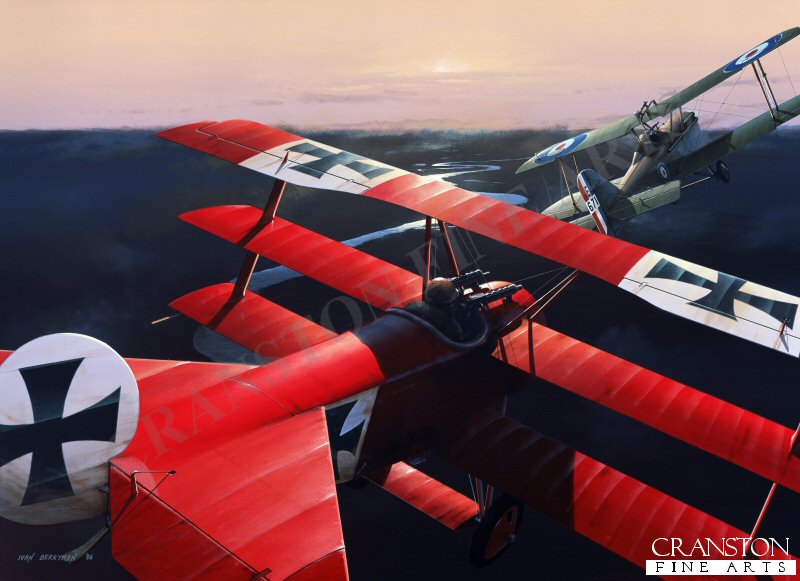
Seeing Red by Ivan Berryman. (PC) Credited with no fewer than 80 victories, Manfred Von Richthofen, The Red Baron, became legendary, not least for the 17 kills scored whilst flying the diminutive Fokker DR1 Triplane. Contrary to popular belief, however, only one of his aircraft is known to have been painted all red. Serial no. 477/17 is shown here dicing with an SE5. |
The Charge of the Red Lancers on Mercer's Troop of Royal Horse Artillery by Chris Collingwood. (PC) Waterloo - 18th June 1815. The Red Lancers made five separate attempts on the allied squares and batteries suffering heavy casualties but failing to break either. Mercer's artillery troop would not retire and served their guns continuously regardless of repeated attack. |
The Battle of Manila Bay by Anthony Saunders. (PC) A splendid little war was how John Hay, ambassador to Britain, described the Spanish-American war of 1898. Though the war was small in scope it was large in consequences; it promoted the regeneration of the American Navy and the emergence of the United States as a major world power. Fought primarily at sea, the war created an American naval legend in its opening encounter between the pacific squadrons of Spain and the United States at Manila Bay on the 1st of May 1898. At sunrise Admiral Dewey, leading the American fleet in his flagship the USS Olympia, had caught the Spanish fleet, under Admiral Patricio Montojo, by surprise - still anchored off Sangley Point at Manila Bay in the Philippine Islands. Defeat for the Spanish was total and heralded the end of a once extensive Spanish empire in the Americas. Montojos flagship, Reina Cristina, is seen here under fire from the Olympia. |
5K+AR Sole Survivor by Ivan Berryman. (PC) Shortly after mid day on 26th August 1940, a Bolton-Paul Defiant of 264 Sqn claimed a victory that was to make history many decades later. Dornier Do.17Z2, Wk No 1160 of 7/III KG.3 had been part of a raiding force sent to attack targets in Essex. Attacked from below, the Do.17 suffered terminal damage and came to rest in the shallow waters of the Goodwin Sands, near Deal in Kent. Two of her crew died in the incident, but two others survived and became prisoners of war. In June 2013, over seventy years later, 5K+AR was raised from the water to be put on display at the RAF Museum in Hendon, becoming the only example of its type to survive anywhere in the world. |
Raid on the Rock - Tribute to the Crews of the Regia Aeronautica by Ivan Berryman. (PC) The only four engined heavy bomber to serve with the Regia Aeronautica, the Piaggio P.108 was built in too few numbers to have any significant effect in the Italian air campaign in World War Two, but was a worthy aircraft with several innovative design features, not least the remotely controlled gun barbettes in the outer engine nacelles. Most notable of the P.108's achievements were a number of daring night time raids on Gibraltar, as depicted here, flying from 274a Squadriglia's base at Decimomannu on Sardinia. |
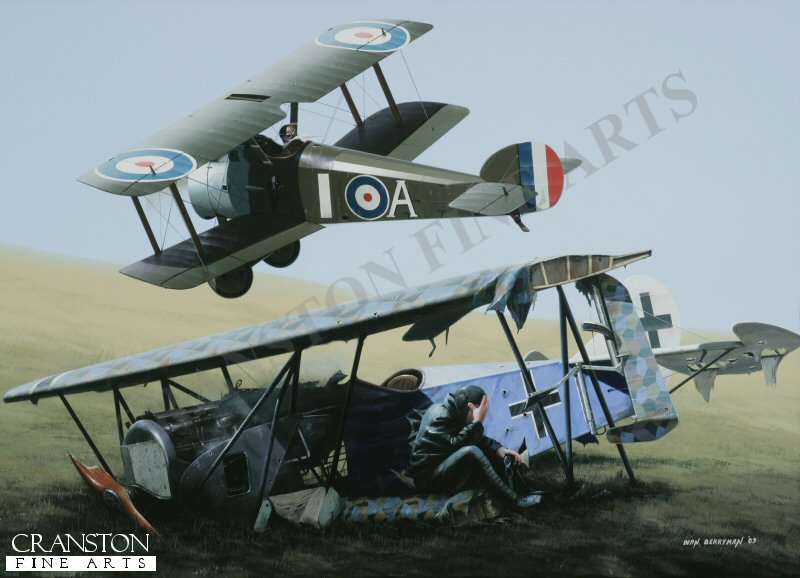
Captain Arthur Henry Cobby by Ivan Berryman. (PC) Arriving in France in 1917 with little or no air gunnery training behind him, Captain Arthur Harry Cobby went on to become the Australian Flying Corps highest scoring ace with 29 victories to his credit, five of them observation balloons. He is shown here in Sopwith Camel E1416 of 4 Sqn AFC (formerly 71 Sqn AFC) having downed one of his final victims, a Fokker D.VII on 4th September 1918. Cobby survived the Great War and served in the RAAF during the inter war period and World War Two, eventually leaving the service as Air Commodore CBE. He died in 1955. |
|
Contact Details |
|
Sign Up To Our Newsletter!
This website is owned by Cranston Fine Arts. Torwood House, Torwoodhill Road, Rhu, Helensburgh, Scotland, G848LE Contact: Tel: (+44) (0) 1436 820269. Email: cranstonorders -at- outlook.com
|
|
|