|
|
|
|
|
 |
|
|
|
|
|
|
|
|
Cranston Fine Arts  Postcards  New for June 2022 |
[UP] - 2024 Postcard releases - New for August 2023 - New for January 2023 - New for June 2022 - New for May 2022 - NEW 2026 Postcard releases - New for 2021 - New for October 2020 - New for March 2020 - New for 2019 |
New postcards published by Cranston Fine Arts in June 2022.
| Navigation | |
| Page 1 of 5 | Page 1 .. Next |
|
|
|
|
|
|
|
|
|
|
|
|
|
|
|
|
|
|
|
|
|
| Navigation | |
| Page 1 of 5 | Page 1 .. Next |
| Text for the above items : |
The Black Watch by Harry Payne. (PC) No text for this item |
Kapitanleutnant zur See Friedrich Christiansen by Ivan Berryman. (PC) During a patrol on 6th July 1918, Christiansen spotted a British submarine on the surface of the Thames Estuary. He immediately turned and put his Hansa-Brandenburg W.29 floatplane into an attacking dive, raking the submarine C.25 with machine gun fire, killing the captain and five other crewmen. This victory was added to his personal tally, bringing his score to 13 kills by the end of the war, even though the submarine managed to limp back to safety. Christiansen survived the war and went on to work as a pilot for the Dornier company, notably flying the giant Dornier Do.X on its inaugural flight to New York in 1930. He died in 1972, aged 93. |
Die Schlacht bei Leipzig : Der Angriff des Brandenburgischen Husaren Regiments von Zeiten No3 bei Mockern, 16th Oktober 1813 by R Knotel. (PC) No text for this item |
The Charge of the 10th Hussars at Beneventi by William Barnes Wollen. (PC) Corunna Campaign, 1809. |
The German Retreat from the Marne, September, 1914 by John Charlton. (PC) The first battle of the Marne, though fought in the early weeks of the war, is generally held to have been the decisive factor in the defeat of German ambitions. When almost within sight of Paris, the great German hordes were suddenly brought to bay and hurled back by the gallant French and British armies, exhausted though the latter were by the long retreat from Mons. |
Royal Horse Artillery by Harry Payne. (PC) No text for this item |
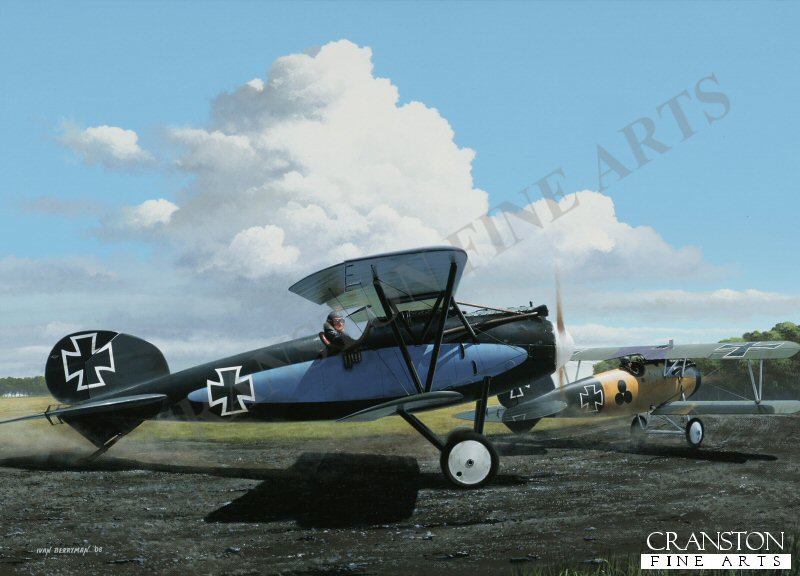
Leutnant d R Viktor Schobinger by Ivan Berryman. (PC) The distinctive black-fuselaged Albatross D.V of Jasta 12s commander taxis out for take off behind the similar machine of Leutnant d R Friedrich Hochstetter at Roucourt, late in 1917. Whilst all of Jasta 12s aircraft possessed black tails, many of them bore their pilots personalised insignia painted large on the fuselage sides. In the case of Hochstetter, it was a stacked shot emblem, whilst others sported castles, diagonal crosses or various geometric shapes. The origin of Schobingers light blue design is unknown, but may have been applied purely for recognition purposes. His final tally was eight victories, while Hochstetter scored just one. |
Charge of the 21st Lancers at Givenchy by John Charlton. (PC) No text for this item |
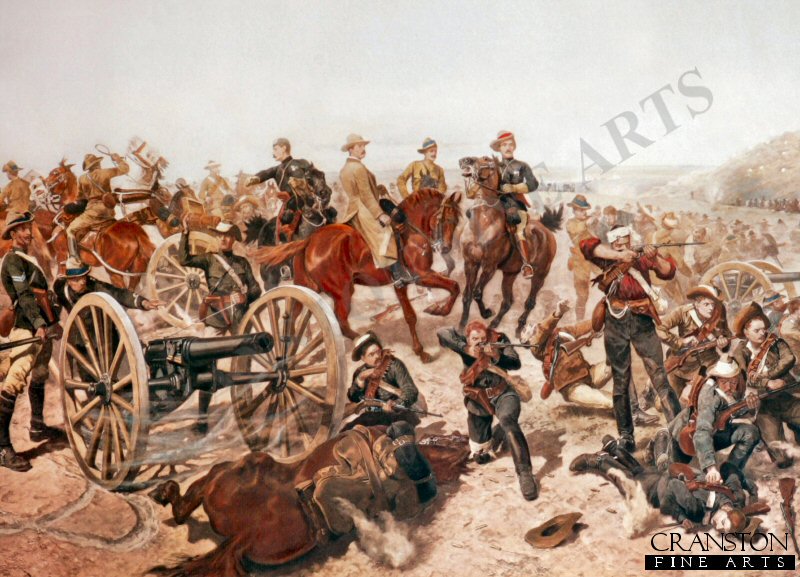
Jameson's Last Stand, Battle of Doornkop 2nd January 1896 by Richard Caton Woodville. (PC) In 1895, Leander Starr Jameson assembled a private army outside the Transvaal with the aim of invading and overthrowing the Boer government. The idea had been to encourage civil unrest among foreign workers (Uitlanders), and use the outbreak of open revolt as an excuse to invade and take over the territory. But Jameson grew impatient and so launched the Jameson Raid on 29th December 1895, and managed to push within twenty miles of Johannesburg before superior Boer forces compelled him and his men to surrender at Doornkop on the 2nd of Janaury 1896. |
A Lost Cause: The Flight of James II After the Battle of the Boyne, 1690 by Andrew Carrick Gow. (PC) No text for this item |
Cutty Sark by Ivan Berryman. (PC) Surely one of the most beautiful of the clipper ships, Cutty Sark is seen driving through a moderate swell en route to the UK with another valuable cargo. She was designed by the great Hercules Linton and her beautiful hull built by Scott & Linton's Dumbarton shipyards but, when that company went bankrupt, the nearby firm of Denby Brothers took over to complete the build. Today she is a magnificent sight, beautifully preserved and on display at Greenwich in London. |
Hannes Trautloft by Graeme Lothian. (PC) Hannes Truatloft is shown here leading Fw190s of JG54 over the Russian Front. Hannes Trautloft is one of the Luftwaffes great fighter leaders, scoring his first air victory in the Spanish Civil War in August 1936. Returning to Germany in 1937 he joined the national aerobatics team flying the Me109. Soon after the outbreak of World War II, Hannes took command of I./JG20 taking part in the Battle of Britain, before moving to the Balkans as Kommodore of JG54. Now leading the group on the Russian Front, JG54 took part in the heavy fighting, first in the Me109, then the Fw190. In the summer of 1943 Hannes Trautloft joined General Gallands staff. As a mutineer he was sacked by Goering, thus ending an illustrious combat career comprising 550 combat missions and 57 aerial victories. |
Tribute to Capitano Antonio Raffi by Ivan Berryman. (PC) Whilst patrolling over advancing Allied troops east of Metemma, three Gloster Gladiators of K Flight, 1 SAAF Sqn, were attacked by Fiat CR.42s from 412a Squadriglia, led by Capitano Antonio Raffi. All three Gladiators were lost in the action, plus a further two that arrived too late to assist. |
French Artillery Crossing the River Aisne, September 1914 by John Charlton. (PC) Another incident in the retreat of the Germans from the Marne. They were pursued by the French and British to the River Aisne. Although the bridges had been destroyed, pontoon bridges were hastily constructed, and the French artillery is here seen crossing in face of the enemy's fire from the other flank. |
Close Combat - The 31st Victory by Ivan Berryman. (PC) Barely 300m above the distinctively meandering Piave River on 17th April 1918, an intense aerial battle took place between Sopwith Camels of 28 Sqn RFC and pilots of Flik 41J of the Austro-Hungarian Air Force near Arcade, north east of Venice. The Commander of Flik 41J, Godwin von Brumowski, the Austro-Hungarian 'Ace of Aces', dueled with Lieutenant W C Hargrave, flying Camel B6342, a battle in which the distinctive red Albatros D.III (Oef) 153.45, emblazoned with its identifying skull motifs gained the upper hand, sending Lt Hargrave's machine to the ground to claim victory number 31. This 'kill' was shared that day with Oblt Friedrich Navratil, the first of his 10 victories, whose aircraft can be seen in the distance. |
Death of a Titan - Musashi by Randall Wilson. (PC) No text for this item |
101st Airborne en route to Normandy by Ivan Berryman. (PC) A Douglas C-47 of the 91st Troop Carrier Squadron, 439th Troop Carrier Group gets away from the Devon airfield of Upottery on 5th June 1944 carrying paratroops of 101st Airborne Division. The company departed from Upottery airbase in Devon, England, and dropped over the Cotentin Peninsula of Normandy, France in the early hours of the morning of June 6th, 1944 at the start of the Normandy invasion. |
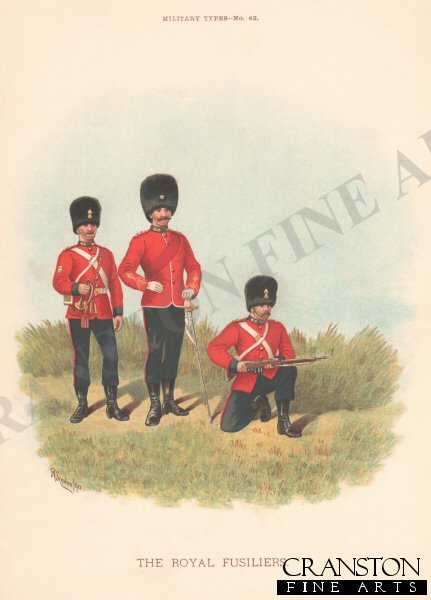
The Royal Fusiliers by Richard Simkin. (PC) No text for this item |
Biggin Trio by Ivan Berryman. (PC) A trio of Spitfire Mk1s of 603 Sqn based at Biggin Hill are depicted on patrol in the Summer skies above Kent during the height of the Battle of Britain in August 1940. Lead aircraft is N3288 XT-H flown by Plt Off George Gilroy who finished the war with 14 confirmed victories, 10 shared and a further 14 aircraft destroyed in actions in which he was directly involved. |
The British Army - 5th (Royal Irish) Lancers by Harry Payne. (PC) No text for this item |
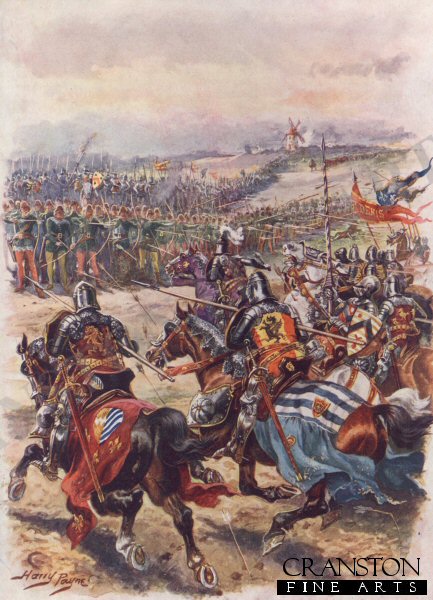
Charge of the French Cavalry, Battle of Crecy by Harry Payne. (PC) Battle of Crecy. One of the battles fought during the Hundred Years War, on 26th August 1346. On 12th July Edward III landed in Normandy with his army and marching north plundered the countryside. King Philip VI assembled an army to stop Edward and tracked them across the Somme River. When Edward reached Crecy he stopped and ordered his army to take up defensive positions. King Philip surveyed the English positions and decided to postpone his attack until August 27th. However, the French vanguard pressed forward too far and so committed the entire army to the battle. The hired Genoese crossbowmen began the assault but came under severe attack from the English longbows and so fled to the rear. King Philip then ordered his cavalry to charge resulting in a huge loss of horse and man under the barrage of arrows which rained down on them. By the end of the night after several unsuccessful assaults the French army was reduced by a third and King John of Luxemburg was dead. Edward then turned towards Calais. |
|
Contact Details |
|
Sign Up To Our Newsletter!
This website is owned by Cranston Fine Arts. Torwood House, Torwoodhill Road, Rhu, Helensburgh, Scotland, G848LE Contact: Tel: (+44) (0) 1436 820269. Email: cranstonorders -at- outlook.com
|
|
|