|
|
|
|
|
 |
|
|
|
|
|
|
|
|
Cranston Fine Arts  Postcards Postcards  2024 Postcard releases 2024 Postcard releases |
[UP] - 2024 Postcard releases - New for August 2023 - New for January 2023 - New for June 2022 - New for May 2022 - NEW 2026 Postcard releases - New for 2021 - New for October 2020 - New for March 2020 - New for 2019 |
New postcards published by Cranston Fine Arts in 2024.
| Navigation | |
| Page 1 of 15 | Page 1 .. Next |
|
|
|
|
|
|
|
|
|
|
|
|
|
|
|
|
|
|
|
|
|
| Navigation | |
| Page 1 of 15 | Page 1 .. Next |
| Text for the above items : |
Death of Prince Poniatowski On October 19th 1813 by Horace Vernet (PC) No text for this item |
Return of Frithiof by August Malmstrom (PC) Frithiof's Saga tells the story of Frithiof, a heroic Viking who embarks on a journey filled with adventure, love, and betrayal. Written in 14th century Iceland, but taking place in Norway during the 8th century, the saga narrates bow Frithiof falls in love with the beautiful Princess Ingeborg, but their romance is thwarted by her father, King Ring, who demands that Frithiof prove his worth by completing a series of heroic deeds. |
General Ludwig von Yorck Near Wartenburg on October 3rd, 1813 By Richard Knotel (PC) Pictured here, Field Marshal General Ludwig von Yorck honours the brave 2nd Battalion of the Life regiment by uncovering his head. Von Yorck would go on to be known as von Wartenburg as a battle honour after his corps won the action at Warternburg; playing a major role in the Prussian victories in Germany against Napoleons forces. |
Holding the Line at All Hazards by Gilbert Gaul (PC) Part of the classic collection. |
The Siege of Vicksburg - May 16th to July 4th, 1863 by Henry Alexander Ogden (PC) The Siege of Vicksburg was a pivotal campaign in the American Civil War where Union forces, led by General Ulysses S. Grant encircled the Confederate stronghold of Vicksburg, Mississippi. The city’s strategic location on the Mississippi River made it vital for supply and communication lines. After weeks of relentless bombardment and dwindling supplies, the Confederate defenders surrendered, giving the Union complete control of the Mississippi River and a significant advantage in the war. This victory, along with the simultaneous Battle of Gettysburg, marked a turning point in the conflict. |
On Hostile Ground - Nelson at Copenhagen After the Battle by Thomas Davidson (PC) Depicting Nelson stepping ashore at Copenhagen in 1801, following his destruction of the Danish fleet and victory in battle. |
The Capture of General Cambronne By Richard Knotel (PC) The English Colonel Hugh Halkett captures the French General Pierre Cambronne at the forecount of the Landwehr battalion Osnabruck during the Battle of Waterloo, June 18, 1815. |
Dunkirk by Ivan Berryman (PC) Between 24th may and 4th June 1940 an extraordinary armada of craft, large and small, naval and civilian, embarked on one of the greatest rescue missions in history. the evacuation of 330,000 British and French troops from the beaches of Dunkirk in northern France. the destroyer HMS Wakeful dominates the foreground here as troops pour onto the beaches and harbour moles in search of salvation. Both Wakeful and distant HMS Grafton were lost during the evacuation. Additional colour added to enhance this previously black and white image. |
The Knights Wrath by Ivan Berryman (PC) A Templar Knight of the medieval order best known today as the Knights Templar. Existing from the early 12th century for nearly two hundred years when they were disbanded by the Pope after members in France were arrested, tortured and murdered under the orders of King Philip IV, the order are closely linked to The Crusades and faded as an organistaion after the Holy Land was lost. King Philip IV was in deep financial debt to the order who had grown rapidly in wealth and made innovations in early banking and he used the end of the Crusades to successfully push for the disbandment of the order. |
The War Party by Edgar Samuel Paxson. (PC) During the frontier times, Native American raiding parties were often organized groups that conducted strategic and targeted attacks on settlers and military outposts. These raids were a response to encroaching European-American expansion, which threatened their lands and way of life. The raiding parties typically utilized their deep knowledge of the terrain and guerrilla warfare tactics to launch swift surprise attacks. |
Colonel Castex Feeds The Horses Before A Charge by Henri Dupray (PC) Colonel Castex of the 20th Chasseurs watering a horse prior to a charge made on Austrian lancers on April 30th 1809 during the War of the Fifth Coalition. Castex would go on to lead his men valiantly in the Battle of Wagram, and was promoted to General of the 3rd Brigade of Light-Cavalry. He would go on to fight in many significant battles in Russia, Germany and France, before being wounded in Saint-Trond. |
The Battle of Ligny on June 17, 1815 By Richard Knotel (PC) August Von Gneisenau, stopping at the height of Brye at dusk orders the retreat to Wavre upon taking command of the Prussian Army after Field Marshal Blucher was incapacitated when his horse was shot and fell upon him. |
Victory of Bluchers Cavalry Near Haynau on May 26, 1813 By Richard Knotel (PC) The Battle of Haynau was fought between Prussian cavalry under the command of General Hebhard Leberecht von Blicher and a French infantry division commanded by General Joseph Maison. The battle ended with a Prussian victory, with 20 squadrons of Landwehr cavalry attacking the French infantry by surprise, inflicting just short of 1500 casualties to the French. |
A Cavalry Charge by Hermanus Willem Koekkoek (PC) Likely during the Battle of Worth, 6 August 1870. The Battle of Worth was a decisive victory for the German Third Army under Crown Prince Friedrich Wilhelm against the French First Corps led by Marshal Patrice MacMahon. Despite the bravery of the French cavalry, their efforts were insufficient to prevent a rout, leading to significant French casualties and a crucial German advance in the Franco-Prussian War. One of the most dramatic moments of the engagement was when the French right flank was collapsing. The cavalry launched a desperate and heroic charge to cover the retreat, but it ended disastrously due to the overwhelming firepower and numbers of the German forces. |
Frederick the Great Surveying the Field of Battle by Hugo Ungewitter (PC) Frederick the Great was the King of Prussia from 1740 to 1786 known for his military genius, enlightened absolutism, and significant contributions to the development of Prussian statecraft. He expanded Prussias territories through a series of successful military campaigns, notably during the Silesian Wars and the Seven Years War. |
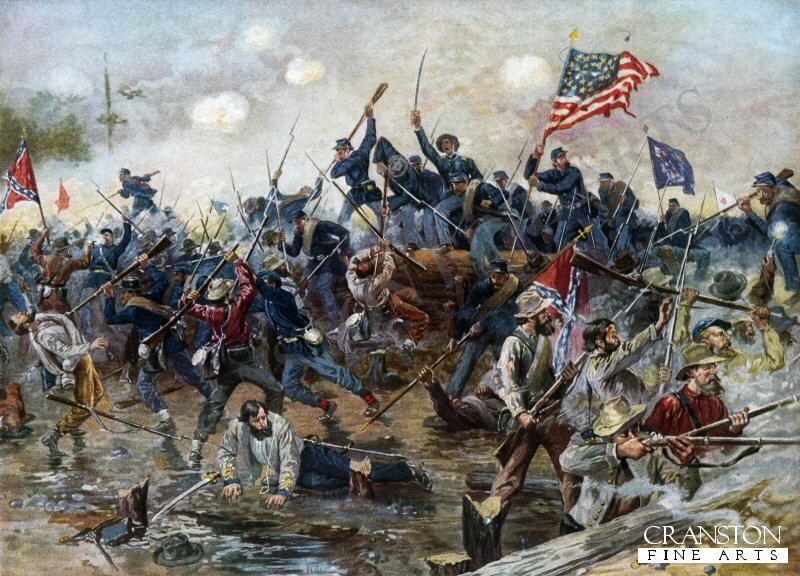
The Battle of Spotsylvania - May 8th to 21st, 1864 by Henry Alexander Ogden (PC) The Battle of Spotsylvania Court House was a brutal and intense engagement in the Overland Campaign, marked by fierce combat and significant casualties, where Union General Ulysses S. Grant sought to outmaneuver Confederate General Robert E. Lee but ultimately failed to achieve a decisive breakthrough. |
The End by David Pentland. (PC) An abandoned Me262 shown in 1945 at the end of Work War Two. |
The Entry of Emperor Franz I into Vienna on 16 June 1814 by Johann Peter Krafft (PC) Emperor Franz I surrounded by a crowd celebrating the signing of the 1814 Treaty of Paris, which ended the war between Napoleon and the Sixth Coalition, often referred to as the First Peace of Paris. |
The Battle of Hagelberg on August 27th, 1813 By Carl Rochling (PC) The Battle of Hagelberg was a surprise attack on a French encampment of around 9000 soldiers by 14 Prussian Landwehr Battalion and 12 cavalry squadrons. There had been a torrential downpour of rain for the entire day of the attack so the powder for the soldiers rifles had gotten damp, this meant that a lot of the fighting was done with bayonets and rifle butts. The skirmish came to a decisive end when Russian Cossacks joined the action, forcing a French retreat, although only a third of the French managed to escape unharmed. |
Essuyant Le Feu by Alphonse De Neuville (PC) Part of the classic collection. |
Nelson Boarding The San Josef At The Battle of St Vincent by Edward S Hodgson (PC) The San Josef - originally named San Jose was a Spanish 112-gun 1st rate ship of the line that was captured by Nelson during the Battle of Cape St Vincent. It became Nelsons flagship during the defence of the channel in 1801. Pictured here is the moment Nelson and his men storm the San Josef. |
|
Contact Details |
|
Sign Up To Our Newsletter!
This website is owned by Cranston Fine Arts. Torwood House, Torwoodhill Road, Rhu, Helensburgh, Scotland, G848LE Contact: Tel: (+44) (0) 1436 820269. Email: cranstonorders -at- outlook.com
|
|
|