|
|
|
|
|
 |
|
|
|
|
|
|
|
|
Cranston Fine Arts  Postcards Postcards  New for January 2023 New for January 2023 |
[UP] - 2024 Postcard releases - New for August 2023 - New for January 2023 - New for June 2022 - New for May 2022 - NEW 2026 Postcard releases - New for 2021 - New for October 2020 - New for March 2020 - New for 2019 |
New postcards published by Cranston Fine Arts in January 2023.
| Navigation | |
| Page 2 of 5 | Previous .. Page 2 .. Next |
|
|
|
|
|
|
|
|
|
|
|
|
|
|
|
|
|
|
|
|
|
| Navigation | |
| Page 2 of 5 | Previous .. Page 2 .. Next |
| Text for the above items : |
Moonlight Despatch by Ivan Berryman. (PC) The role of the frigate in Nelson's navy was one of the most varied of all the ships of the line, but their great speed made them ideal as communications vessels, carrying vital despatches between ships, squadrons and the Admiralty. |
U-453 by Ivan Berryman. (PC) The Type VIIC U-Boat U-453 began service in June 1941 under the command of Knight's Cross winner Egon-Reiner von Schlippenbach and claimed 10 vessels sunk including the Royal Navy minesweeper HMS Hebe. U-453 was sunk on 21st May 1944 by the destroyers HMS Tenacious, HMS Termagant and HMS Liddesdale off the coast of Italy. She is shown here on one of 17 patrols defending herself from air attack by a Catalina from RAF Coastal Command. |
Hindenburg at Baltimore by Ivan Berryman. (PC) Late in the afternoon of Saturday, 8th August 1936, the giant German airship Hindenburg appeared in the sky above Baltimore. Unable to land at nearby Lakehurst due to unfavourable weather conditions, her Captain Ernst A Lehmann made the decision to take his passengers on a sight-seeing tour until the weather conditions improved, taking the great ship over Atlantic City and Washington before heading north to the city of Baltimore where she circled twice at an altitude of just 1,000ft. After 15 minutes, the Hindenburg slid away to Philadelphia, finally landing at Lakehurst at 18.05 after a 5,060 mile flight from Germany which she achieved in 67 hours and 31 minutes. |
Tribute to Savelii Vasil'evich Nosov by Ivan Berryman. (PC) Depicted in early 1945 in his Yak-3 of the 4 IAK special hunter squadron, Lt Savelii Vasil'evich Nosov's aircraft has the blood red rose of this unit. Awarded the Hero of the Soviet Union, he had scored 16 victories in nearly 150 missions by the end of World War Two. |
HMS Eurydice at Anchor off Cowes by Ivan Berryman. (PC) After being re-commissioned under the command of Captain Marcus Augustus Stanley Hare, Eurydice sailed from Portsmouth on a three-month tour of the West Indies and Bermuda on 13th November 1877. On 6th March 1878, she began her return voyage from Bermuda for Portsmouth. After a very fast passage across the Atlantic, on 24 March 1878, Eurydice was caught in a heavy snow storm in Sandown Bay, within sight of the Isle of Wight, capsized and sank. Only two of the ship's 319 crew and trainees survived. Most of those who were not carried down with the ship died of exposure in the freezing waters. One of the witnesses to the disaster was a young Winston Churchill, who was staying at Ventnor with his family at the time. The wreck was re-floated later that same year but had been so badly damaged during her submersion that she was then subsequently broken up. Her ship's bell is preserved in St. Paul's Church, Gatten, Shanklin. There is a memorial in the churchyard at Christ Church, The Broadway, Sandown and the ship's anchor is set into a memorial at Clayhall Cemetery, Gosport. |
Tribute to Pete Brothers by Ivan Berryman. (PC) Pete Brothers is shown here in his Hurricane P2921 GZ-L of No.32 Squadron during the Battle of Britain. In one of 8 victories claimed before September 1940, he has peppered a marauding German Dornier Do.215, its port engine now trailing smoke and flame. In this incident, he had been attacked by Me110s and had stalled while turning to meet them. Spinning out of the stall he immediately sighted, engaged and shot down the Do.215. He claimed an Me109 later the same day. Pete Brothers is credited with a total of 16 victories during World War Two. He died aged 91 in December 2008. |
Zerstörer Break by Ivan Berryman. (PC) Just how vulnerable the pilot and observer of a Messerschmitt Bf.110 were during the early stages of the war is ably demonstrated in this view from the cockpit of a Bf.110C-2 of 1/ZG 52, based at Charleville during the Battle of France in June 1940. Later versions featured an armoured seat and head protection for the pilot. |
Tribute to Lt. James Meissner by Ivan Berryman. (PC) Joining the 94th Pursuit Squadron in France in March 1918, James Meissner scored a total of 8 victories between May and October of that year. Shown here in his Nieuport 28, he scored 4 of his victories flying this aircraft before taking over command of 147th Pursuit Squadron flying a Spad S.XIII in July and scoring his final 4 victories. He died of pneumonia in 1936 but had top American flying Ace Eddie Rickenbacker as a pallbearer, a former colleague from the 94th Pursuit Squadron. |
Day Ranger to Grove by Ivan Berryman. (PC) On 26th September 1944, F/O George Stewart, and his navigator F/O Paul Beaudet flew a Day Ranger with fellow 23 Squadron Pilot F/O D.L,'Bud' Badley, and his navigator Sgt A A Wilson, to Grove Aerodrome in Denmark, in their FB.VI Mosquito fighter bombers. Arriving abruptly over their target, George spotted a Ju.88 sitting by the perimeter track and at once strafed with his four 20mm cannons. He is flying YP-T (HR 201), and Bud, YP-Z (HR 216), seen in the background. Their sudden appearance and departure drew no return fire and, as they raced back to the coast, George couldn't resist a departing shot at a Freya Radar tower, but got hit by a .303 round in his instrument panel as he flew overhead. Bud, however, received numerous hits on his pass, losing one engine, plus rudder, elevator control and R/T. In a superb display of airmanship, at zero feet, Bud regained control and flew back home to land safely at the emergency airstrip at Woodbridge. George, having plunged into low cloud and therefore lost sight of Bud, was unable to raise him on the R/T and flew on to Little Snoring. George and Paul were awarded DFCs, following their extended operational tour, and Bud an 'Immediate' DFC, by W/C 'Sticky' Murphy DSO and Bar, DFC and Bar, Croixe de Guerre and Palm, Commanding Officer of 23 Squadron, RAF. |
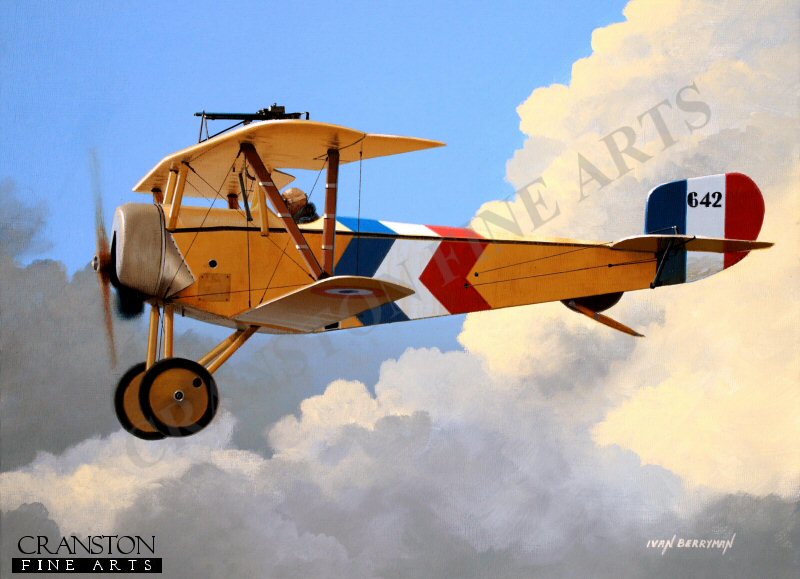
Tribute to Pierre Dufaur de Gavardie by Ivan Berryman. (PC) French Ace Pierre Dufaur de Gavardie claimed a total of six victories - four aircraft and two observation balloons between March and November 1916. He was badly wounded in early 1917 and despite recovering, would not fly in the war again. Pictured here in his Nieuport 11, he flew with Escadrille 12 and was awarded the Croix de Guerre, Legion d'honneur and Medal Militaire. He died aged 76 in 1966. |
Zemke's First Fan by David Pentland. (PC) On the 12th of May 1944, Col. Hubert Zemke tried his new fan tactic, designed to engage Luftwaffe fighters. Unfortunately on this occasion his aircraft was bounced by German ace Major Gunther Rall in his ME109 G-6AS, and escaped only by sending his P47-D Thunderbolt into a gut wrenching dive. |
North Atlantic Predator by Ivan Berryman. (PC) U-99 was commanded by Otto Kretschmer from launch in 1940 until being sunk in March 1941, less than a year later. However, during this time U-99 became one of the most successful submarines of the war, claiming almost 40 ships sunk. Attached to each side of the coning tower is a horseshoe, dredged up by the anchor, painted gold and positioned here for luck. This luck ran out on 17th March 1941 when the destroyers HMS Walker and HMS Vanoc discovered and successfully attacked U-99. Forced to the surface by severe damage, the submarine was then scuttled while forty of the crew including Kretschmer were rescued to become prisoners of war. |
Tribute to Franz Schieß by Ivan Berryman. (PC) Scoring his first victories on the Eastern Front with JG53, Franz Schieß was posted with his squadron to the Mediterranean from December 1941. He shot down aircraft consistently through 1942, operating from Sicily then Tunisia. He achieved his 50th victory in May 1943, claiming one of his eventual unsurpassed tally of 17 P-38 Lightnings. Awarded the Knight's Cross in June 1943, he was sent on leave for two months but returned in August, claiming 12 victories in 11 days. On 2nd September 1943, he was killed when his Me109 crashed into the sea during combat with P-38 Lightnings. He was credited with 67 victories in more than 650 missions. |
Never Say Die by Ivan Berryman. (PC) What must surely be one of WWII's most extraordinary acts of bravery occurred on the night of 16th/17th January 1945 when F/L T A Smith and F/O A C Cockayne were on an ASH patrol over Stendal. Flying Mosquito FB.VI RS507 (YP-C) of No.23 Sqn, they inadvertently stumbled upon the German airfield of Fassberg on their return trip, fully lit up with aircraft taxiing. Taking full advantage of this situation, F/L Smith went straight in to attack, destroying one Bf.109 on the taxiway and another two as they attempted to take off. RS507 received ground fire hits to its starboard engine during the chase down the runway, Smith feathering the prop, but continuing to press home his attack. Knowing that there was no way of saving their aircraft, Cockayne was ordered to bale out, but sadly lost his life in the attempt. F/L Smith fought gallantly to bring his Mosquito down into snow with minimum damage, but the aircraft hit trees before striking the frozen ground and a furious fire broke out, Smith trapped in the wreckage. Against all the odds, he survived the crash, albeit with terrible burns, and saw out the war as a prisoner of the Germans. |
SMS Emden by Ivan Berryman. (PC) SMS Emden served in both Chinese and Pacific waters and was at the German colony of Tsingtao when war broke out. She was ordered to start raiding and disrupting commercial vessels in the Indian Ocean until she was cornered by HMAS Sydney. She was beached after the battle on 9th November 1914 and the wreck was partly scrapped by the Japanese in 1950. Some of her crew managed to reach Germany again after capturing a ship and traveling to Mecca. |
Tribute to Hugo Broch by Ivan Berryman. (PC) Regarded as one of the finest wingmen to have flown, Hugo Broch first flew alongside Horst Adameit (who scored 166 victories) then Bazi Sterr (130 victories) before emerging as one of the superb combat pilots of JG54. Shown here in his Fw190, he scored 81 victories in 324 missions and was awarded the Knight's Cross. |
Tribute to Peter Wykeham-Barnes by Ivan Berryman. (PC) Lattely known as Air Marshal Sir Peter Guy Wykeham, KCB, DSO and Bar, OBE, DFC and Bar, AFC - he is shown here baling out of his stricken Gloster Gladiator of No.80 Sqn over North Africa on 4th August 1940. At the time he would have been known as Peter Wykeham-Barnes - a flying Ace who would go on to score 14 victories plus 3 shared in a wartime career which also saw him fly with No.274 Sqn and command No.73 Sqn, No.257 Sqn and No.23 Sqn. Remaining with the Royal Air Force after the war, he became a test pilot and served with the US Air Force in the Korean War before taking serveral roles in the RAF, culminating in Deputy Chief of Air Staff from 1967 until retirement in 1969. He died in 1995. |
Deutschland at Baltimore Harbour by Ivan Berryman. (PC) On 9th July 1916, with Captain Paul Koenig in command, the German merchant submarine Deutschland entered Baltimore Harbour after a 16-day crossing of the Atlantic from Bremerhaven on a peaceful trade mission and was greeted by a flotilla of tugs and small sight-seeing vessels. Upon arrival in the bay, the German merchant flag was hoisted and many of her 29 crew appeared on her narrow deck to enjoy the moment. The visit was greeted with considerable controversy at the time, given that Europe was at this time at war with Germany, but this unusual event passed peacefully with Deutschland returning home safely the following month. |
Tribute to Heinrich Gontermann by Ivan Berryman. (PC) Originally in Germany's military, Heinrich Gontermann did not become an aviator until early 1916, and was not a fighter pilot until November of that year. Despite this, he is credited with 39 victories including 18 observation balloons. Scoring his first victory in November 1916, he did not score again until the next March - he is shown here in his Albatros D.III of Jasta 5 in April 1917 during which he claimed 12 victories - 5 balloons and 7 aircraft. Highly decorated with awards including the Knight's Cross and Blue Max, he was killed in a crash in the last days of October 1917 while performing aerobatics in his new Fokker Dr.I. |
Tribute to Georg Csurusky by Ivan Berryman. (PC) Initially flying Ju88 bombers with KG51 on the eastern front, George Csurusky converted with his squadron to the Me410 in late 1943. Georg Csurusky flew the Me410 primarily at night. On 22nd April 1944, Me410s of his squadron would have flown in daylight as depicted here to England in order to intercept returning American bombers as the daylight faded. Within twenty minutes, the deadly Me410s had shot down ten bombers for the loss of only two of their own aircraft. Georg Csurusky later converted to the Me262 fighter-bomber, flying 68 of his 209 combat missions in the jet. |
Yellow 10 by Ivan Berryman. (PC) The elegant D-13 was the ultimate example of Focke-Wulf's FW.190 to be powered by the Jumo 213EB inverted inline engine and is still widely regarded as one of the finest aircraft to have entered service with the Luftwaffe in WWII. Armed with three 20mm guns, one of them firing through the propeller spinner, this aircraft proved itself to be an effective weapon for Geschwader Kommodore Major Franz Gotz of JG.26, the great ace claiming 63 victories. His machine is depicted in close-up here - "Yellow 10", Werk No. 836017, based at Furstenau in February 1945. |
|
Contact Details |
|
Sign Up To Our Newsletter!
This website is owned by Cranston Fine Arts. Torwood House, Torwoodhill Road, Rhu, Helensburgh, Scotland, G848LE Contact: Tel: (+44) (0) 1436 820269. Email: cranstonorders -at- outlook.com
|
|
|