|
|
|
|
|
 |
|
|
|
|
|
|
|
|
Cranston Fine Arts  Aviation Art World War One Squadrons UK and Commonwealth  Royal Flying Corps |
[UP] - No.10 Naval Sqn - No.11 Sqn - No.139 Sqn - No.15 Sqn - No.201 Sqn - No.203 Sqn - No.205 Sqn - No.208 Sqn - No.209 Sqn - No.201 Sqn - No.22 Sqn - No.25 Sqn - No.28 Sqn - No.3 Sqn - No.30 Sqn - No.32 Sqn - No.4 Sqn AFC - No.45 Sqn - No.46 Sqn - No.54 Sqn - No.56 Sqn - No.6 Sqn - No.60 Sqn - No.62 Sqn - No.64 Sqn - No.65 Sqn - No.69 Sqn - No.73 Sqn - No.74 Sqn - No.8 Sqn - No.84 Sqn - Royal Aircraft Establishment - Royal Flying Corps |
Royal Flying Corps
Country :
| Navigation | |
| Page 1 of 2 | Page 1 .. Next |
| Royal Flying Corps Aviation Art Prints, Paintings and Drawings |
|
|
|
|
|
|
|
|
|
|
|
|
|
|
|
|
|
|
|
|
|
| Navigation | |
| Page 1 of 2 | Page 1 .. Next |
| Text for the above items : |
Original Pencil Sketch for Battle of Cambrai, France, 20th November 1917 by David Pentland. (P) At 0620 hours covered by a brief barrage from 1000 guns, the tanks of C and F Battalions in MkIV tanks advanced alongside the men of the British 12th Division against the impregnable German Hindenburg line at Cambrai. Supported in the air by 4 RFC squadron flying ground attack missions, the general offensive had broken through 3 trench lines and penetrated 5 miles on a 6 mile front by lunchtime. Although these gains were not exploited and later retaken by a German counter offensive, Cambrai showed the full potential of the tank on the battlefield. |
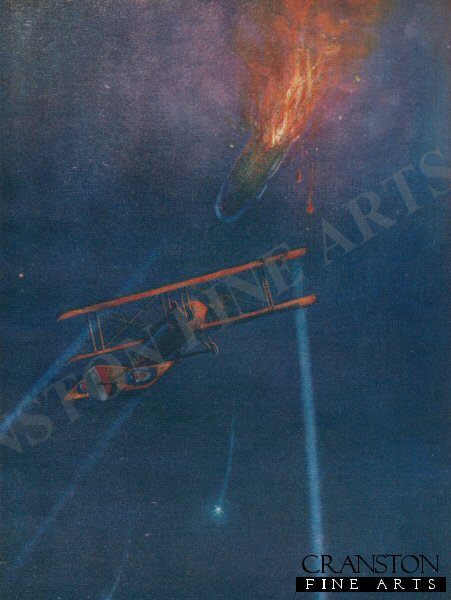
Lieutenant W L Robinson Attacks an Enemy Airship and Brings it Down in Flames by W Avis (P) On the night of September 2nd-3rd 1916. Lieutenant William Leefe Robinson, of the Worcester Regiment and Royal Flying Corps, attacked an enemy airship under circumstances of great difficulty and danger, and sent it crashing to the ground as a flaming wreck at Cuffley, near Enfield. He had been in the air for more than two hours, and had previously attacked another airship during his flight. For this act of most conspicuous bravery he was deservedly rewarded with the VC. |
Captain William Billy Bishop by Ivan Berryman. Undoubtedly one of the truly great Aces of the First World War, William Billy Bishop became celebrated for his technique of actively seeking out the enemy and bringing the fight to him, rather than the more usual practice of patrolling in search of enemy activity. An example of this was his single-handed attack on a German airfield in June 1917 when he destroyed not only a number of aircraft on the ground, but then successfully despatched another seven Albatross scouts that took off to engage him. For this action, he was awarded the Victoria Cross in August 1917 and his final tally when the war ended was 72 confirmed victories. He is depicted here in his Nieuport Scout B1566 in combat with a Pfalz D.III. |
Observer / Gunner, Royal Flying Corps 1917 by Chris Collingwood. No text for this item |
Sopwith Camel by Anthony Saunders. The Sopwith Camel was with the mainstay of the Royal Flying Corps. It is shown here downing an Albatros over the Western Front. |
Albert Ball by Ivan Berryman. Albert Ball in his Nieuport 17 having just shot down a German LVG. His aircraft, A134, was distinctive in having a bright red spinner. He was the first Royal Flying Corps pilot to score a hat-trick (3 kills on a single mission) and, in the course of his career, scored another two on his way to his outstanding 44 victories. |
William Leefe-Robinson by Ivan Berryman. Lieutenant Leefe-Robinsons BE2C, converted to single-seater night-fighter configuration, destroying the German SL11 over Hertfordshire on the night of 2/3 September, 1916. Robinson attacked the SL11 from below, raking it with incendiary fire, before turning and diving past the airship for another attack. As he did so, the airship exploded into flames and crashed into a field near Cuffley, killing all sixteen crew. For this action, Leefe-Robinson was awarded the VC. |
To the Green Fields Beyond, Cambrai, France, 20th November 1917 by David Pentland. At 0620 hours covered by a brief barrage from 1000 guns, Brigadier General Elles in a MkIV called Hilda led his 476 tanks against the impregnable German Hindenburg line at Cambrai. Supported by 6 infantry divisions and 4 Royal Flying Corps squadrons flying ground attack missions, the attack had broken through 3 trench lines and penetrated 5 miles on a 6 mile front by lunchtime. Although these gains were not exploited and later retaken by a German counter offensive, Cambrai showed the full potential of the tank on the battlefield. |
A Zeppelin over London by Ivan Berryman. From 1915 to 1917, there existed a very real threat of a bombing campaign on mainland Britain as the giant German airships drifted silently and menacingly across the English Channel and the North Sea to deliver their deadly cargo on the towns and cities of the east coast. Countermeasures were soon put into action as powerful searchlights picked out the Zeppelins for the anti-aircraft batteries and RFC pilots to pour their unrelenting fire into the raiders, sometimes with little effect, sometimes with catastrophic results. Here, 2nd Lieutenant Brandons BE.2 climbs for position, its exhaust pipes aglow in the dark, whilst flak bursts all around the massive bulk of the L.33 as she passes over the east end of London on the night of 23 / 24th September 1916. |
Vickers Gunbus FB5 by Tim Fisher. This aircraft entered service with the RFC in February 1915. Nicknamed the gunbus, it was the first British aircraft to be designed as a fighting machine from the start. The plane was armed with a single .303 inch Lewis machine gun, fired by the observer. It was only a short period of time before it was outclassed by German aircraft carrying synchronised forward firing machine guns. |
Moonlight Renegade by Stan Stokes. On July 2, 1900 Count Ferdinand von Zeppelin piloted his first rigid-framed, lighter-than-air ship over Lake Constance in Germany. Seventeen years later, on June 16, 1917, Zepellins latest creation, the L-48, was readied at Nordholz, Germany for its first combat mission. The huge L-48 was one of the newest and most technically advanced German airships. Powered by five 250 HP Maybach engines, the great airship could carry 6,000 pounds in bombs, and was manned by a crew of nineteen. For this maiden mission the commodore of the North Sea Airship Division, Victor Schutze, would be joining the L-48s skipper Kapitain-lieutenant Franz George Eichler. Early in the afternoon the L-48 commenced its mission along with several other airships from the Nordholz base. The great Zeppelin would cruise at 60 MPH at 5,000 to 10,000 feet and would ascend to approximately 20,000 feet when approaching its target. This altitude would provide an effective defense against both anti-aircraft or British fighters. RAF Captain Robert Saundby, had returned from the front, to be put in charge of a very small RFC squadron at Oxford Ness. June 16 was a cloudless night, perfect for a Zeppelin attack., and at 11:15 PM Saundby launched his two active aircraft equipped with incendiary machine gun bullets. As he gazed up at the stars at 1:00 AM Saundby was startled to see a huge zeppelin outlined by searchlights only a few miles away. Awakening two of his mechanics, Saundby instructed them to fire up his single-seat DH2 fighter. Although obsolete and not equipped for night fighting, Saundby, who had never flown at night, got the little pusher-propeller fighter in the air, and began a long ascent. After fifteen minutes of flying Saundby spotted the L-48, which was by now attracting anti-aircraft fire which was exploding several thousand feet below the great airships altitude. For an hour or so, Saundby tried to coax every bit of altitude out of his little DH2, but he could not get in range. At around 3:00AM the L-48 completed its bombing runs, and the Captain set a due north course. With dawn only an hour away, Captain Eichler was anxious to get out of British airspace. A report from an observation airship which had accompanied the strike force that evening indicated favorable winds at 13,000 feet. Captain Eichler gave the orders to descend. Meanwhile, Captain Saundby who had fought the cold and wind while tailing the L-48 for nearly three hours, was startled to see the great airship descending. Pushing his DH2 to the limit, Saundby emptied 8 canisters of incendiaries at the L-48. Recognizing the attack the L-48 dumped ballast, and immediately began to ascend. Saundbys last few round met their target and the L-48 erupted. Saundby felt the surge of heat and light, and struggled to keep his little craft under control. Within minutes the L-48s maiden mission was over, as Saundby circled the 750 foot long fireball which had come down at Westford. Amazingly, two of the L-48s crewmembers survived, the only people to ever survive a zeppelin which had been ignited. One of these survivors, Kapitanlieuntenant Meith wrote a letter describing the L-48s fateful misssion, providing much of the historical basis for this incident. |
Zeppelin Gunners by Ivan Berryman. Droning over the coast en route to another night attack on mainland Britain, the Zeppelins top gun platform goes into action as BE.2 fighters wheel around the gas-filled giants, trying desperately to fire their Brock, Pomeroy and Sparklet ammunition into the volatile gasbags that lay beneath the Zeppelins skin. Often freezing cold, always vulnerable, the defensive gunners occupied a tiny, sunken recess on the very top of the airship, shielded from the buffeting winds only by a shallow screen and their thick leather flying suits. Just a handrail and a shallow step lay between them and a vertiginous drop over the rolling sides of their massive craft. Their air-cooled Parabellum MG.14 machine guns did little to repulse their attackers, whilst the great Zeppelins offered themselves as huge, bloated targets for ground artillery as well as the brave pilots of the RFC. |
Knights of the Sky by Nicolas Trudgian The dramatic scene depicts an aerial dog-fight between Sopwith Camels and SE5A fighters of the Royal Flying Corps, and the bright red planes of Baron von Richthofens JG1 fighter wing. High over Northern France, the highly manoeuvrable fighters wheel and turn in the cauldron of close aerial combat, the artist bringing alive that evocative era when aerial combat first began. |
Battle of Cambrai, France, 20th November 1917 by David Pentland. At 0620 hours covered by a brief barrage from 1000 guns, the tanks of C and F Battalions in MkIV tanks advanced alongside the men of the British 12th Division against the impregnable German Hindenburg line at Cambrai. Supported in the air by 4 RFC squadron flying ground attack missions, the general offensive had broken through 3 trench lines and penetrated 5 miles on a 6 mile front by lunchtime. Although these gains were not exploited and later retaken by a German counter offensive, Cambrai showed the full potential of the tank on the battlefield. |
Lieutenant Rhodes-Moorhouse Flying Over Courtrai to Bomb the Railway by Allan Stewart. On April 26th 1915, 2nd Lieutenant William Barnard Rhodes-Moorhouse, of the Special Reserve, Royal Flying Corps, set out from the British lines for the purpose of raiding the railway at Courtrai. On reaching the place he planed down to a height of 300 ft, and, under heavy shell fire, bombed the railway near the station. As he started on his return journey he received a mortal wound, but with great pluck and determination kept control of his aeroplane. He flew back, at a very low altitude, a distance of 35 miles to his starting point, and reported the success of his undertaking. He subsequently died of his wounds, but for his most conspicuous bravery a posthumous award of the VC was made. |
The Big Push - Passchendaele 1917 by Anthony Saunders. Swamped by mud amidst a desolate, shattered landscape, men and horses of the Royal Field Artillery drag their 18 pounder field-gun towards a new position on 15 November 1917, during the final days of the Battle of Passchendaele. Whilst the army continues its grim fight on the ground, overhead Sopwith Camels from 45 Squadron Royal Flying Corps tangle in an equally deadly duel with German Albatros fighters of Jasta 6. Flying the lead Sopwith Camel is the RFC Ace, 2nd Lt Kenneth Montgomery who scored the last of his 12 victories in this dogfight when he shot down the German Ace Leutnant Hans Ritter von Adam, the Commanding Officer of Jasta 6 with an impressive 21 victories to his name. To commemorate one of the most significant anniversaries in history, Anthony Saunders has created a powerful painting portraying the bleak sacrifice made by so many heroic young men. The names of the bitter battles they endured, however, still live on a hundred years later - Ypres, the Somme, Vimy Ridge, Arras, Loos - and one of the most savage - Passchendaele. |
Lieutenant George F. Pretyman, Of The Royal Flying Corps, Blowing Up A Train. Believing that the enemy was concentrating men for a big attack at some point on the Allied lines, Lieutenant Pretyman ascended in his aeroplane to make a reconnaissance. On looking down on the station at Don he saw a battalion forming up outside the railway buildings. Circling back over the station with shrapnel bursting all round him, he dropped a bomb on a train, completely wrecking the centre of it, as it stood ready alongside the platform. Though a German aeroplane swept down to attack him, he drove it off. Lieutenant Pretymans great gallantry, ability and initiative were afterwards rewarded with the D.S.O. |
Air Mechanic Prance Assisting To Repair An Aeroplane Under Heavy Shellfire. During the battle of Neuve Chapelle, March 10th-12th 1915, great activity was shown by the British airmen, whose plans were brilliantly conceived and executed. The weather, however, was extremely bad for flying, and it compelled the airmen to fly no higher than one hundred to one hundred and fifty feet, and thus run great risks. On the night of March 10th, one of the British aeroplanes was forced to descend near the firing line, and 2nd class Air Mechanic J. E. Prance, of the Royal Flying Corps, set to work to help in repairing it. Shells burst all round Prance and his comrade, but the two men worked with such enthusiasm that the machine was ready for flying the next morning. For his valuable services Prance was rewarded with the D.C.M. |
Squadron Commander Davies ascending in his aeroplane after taking flight Sub Lieutenant Smylie onboard. The enemy were soon hard on the track of Lieutenant Smylie. But, having descended at a safe distance from the burning aeroplane, Commander Davies took up Lieutenant Smylie and returned to the aeroplane. For skill and gallantry this feat of airmanship can seldom have been equalled, and Commander Davies was deservedly rewarded with the V.C. This item depicts the event in November 1915 for which Richard Bell Davies (subsequently Vice Admiral) was awarded the Victoria Cross on 1st January 1916. During a bombing mission over Bulgaria, the aircraft of Sub Lt Gilbert Smylie was damaged by ground fire and forced to land. He jettisoned his bombs while still in the air, but one failed to release and remained with the aircraft as it crash-landed. Smylie set fire to his machine and set to depart, intending for the remaining bomb to explode in the flames, but saw Squadron Commander Bell Davies descending towards the burning wreckage. He returned to the ordnance and detonated it by means of a pistol shot from close range ensuring the safe descent and landing of Bell Davies' aircraft. With the enemy approaching, Bell Davies took Smylie into his machine in the most cramped conditions, but returned to the aerodrome safely. For this, Bell Davies was awarded the Victoria Cross and Smylie the Distinguished Service Cross. It is thought to have been the first combat rescue by aircraft of this kind in history. |
Second Lieutenant Henderson Flying down into the British lines after his left leg had been severed by a shell. While making a photographic reconnaissance over the enemys lines, the aeroplane in which Second Lieutenant (temporary Lieutenant) Malcolm Henderson, of the 4th (Ross Highland) Battalion, Seaforth Highlanders (Rosshire Buffs, the Duke of Albanys) Territorial Force, and Royal Flying Corps, was flying, was struck by a shell from a German anti aircraft gun. Passing through the nacelle of the machine, the shell took off Lieutenant Hendersons left leg just below the knee. In spite of this serious injury he succeeded in planing down from a height of 7,000 feet and in safely landing 3,000 yards behind the British lines. His cool and courageous action, for which he was awarded the D.S.O. saved the life of the observer. |
Second Lieutenant Strange bombing the railway junction at Courtral. For his gallantry and ability on reconnaissance and other duties on numerous occasions, but especially on the occasion when he dropped three bombs from a height of only two hundred feet on the railway junction at Courtrai, whilst being assailed by heavy rifle fire, Second Lieutenant (temporary Captain) L. A. Strange, of the Dorsetshire Regiment and Royal Flying Corps, was awarded the M.C. |
Royal Flying Corps
|
Contact Details |
|
Sign Up To Our Newsletter!
This website is owned by Cranston Fine Arts. Torwood House, Torwoodhill Road, Rhu, Helensburgh, Scotland, G848LE Contact: Tel: (+44) (0) 1436 820269. Email: cranstonorders -at- outlook.com
|
|
|