|
|
|
|
|
 |
|
|
|
|
|
|
|
|
Cranston Fine Arts  Naval Art World War Two Countries Naval Art World War Two Countries  Germany Germany |
[UP] - United Kingdom - United States - Germany - Japan - Italy - Australia - France - Netherlands |
| More Pages : Submarines |
| Navigation | |
| Page 4 of 6 | Previous .. Page 4 .. Next |
|
|
|
|
|
|
|
|
|
|
|
|
|
|
|
|
|
|
|
|
|
| Navigation | |
| Page 4 of 6 | Previous .. Page 4 .. Next |
| Text for the above items : |
Schnell Boats Operating in the Baltic by Randall Wilson. German Schnell Boats were heavily armed coastal craft often referred to by the Royal Navy as E-boats. Fast, and better armed than the Royal navy MTBs and PT-boats, they became the most effective inshore attack craft of World War Two. Lurssen built the first German MTB in 1930, originally called UZ16 it would later become W1 and finally S1 in 1932. All German Schnell Boats would carry two seperate torpedo tubes. In total 249 Schnell Boats were built for the Kriegsmarine, with a total of 157 being lost or scuttled. The last 92 were split between the Allies with 30 going to the US, 34 going to United Kingdom and 28 to Russia. |
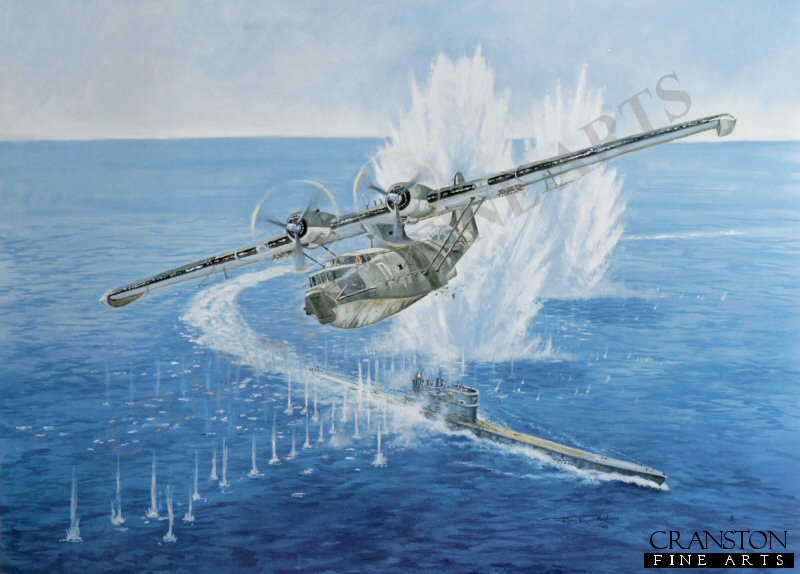
Catalina Attack by John Wynne Hopkins. D for Donald of 270 squadron, Royal Air Force, out of Freetown, West Africa operating in the Atlantic Ocean. It was during routine operation search that D for Donald surprised U515 on the surface and immediately attacked the submarine. U515 in putting up stiff resistance blew a large hole in the hull of D for Donald and the magazine of the starboard side 0.5 twin Browning was hit and the subsequent shrapnel wounded both blister gunners. U515 escaped but was sunk by an American naval hunter group a year later. D for Donald limped back to base and managed to make the beach before it would sink completely. |
Tribute to the U-Boat Commanders by Jason Askew. (P) A U-Boat is shown under attack from depth charges. The portrait shows U-Boat commander Erich Topp with the Swordfish emblem of the 11th Flotilla. |
U-47 by Ivan Berryman. Under the command of Günther Prien, the deadly U-47 became the 10th most successful U-Boat of World War Two in terms of tonnage sunk. However, on 8th October 1939 she sank the British battleship HMS Royak Oak within Scapa Flow, the main British naval base of the war, despite the anti-submarine measures in place. The submarine was presumed lost with all hands when she failed to return from her 10th patrol in March 1941, although no definitive explanation for her loss exists. |
U-99 by Ivan Berryman. Famed for his night time surface attacks on convoys, Otto Kretschmer, commanding U-99 is shown having claimed another victim beneath a full moon during the Summer of 1940. |
Knight's Move by Robert Taylor The awesome battleship Tirpitz under the command of Admiral Schniewind, in company with battleships Scheer and Hipper, setting sail during Operation Rosselsprung, destined for the open sea and the North Atlantic convoy traffic. Messerschmitt Me109s of JG5, based at Petsamo, provide overhead cover while flotilla escort vessels make up the fearsome armada. The magnificent Norwegian mountains provide a spectacular backdrop this comprehensively realistic and stirring World War Two image. |
Exercise Tiger by Ivan Berryman. (PC) As part of a rehearsal for the impending D-Day landings on 6th June 1944, eight tank landing ships (LSTs), together with two destroyers, embarked most of their American troops on a British beach and began making their way to Slapton Sands. This was the night of 27th / 28th April and, unseen in the darkness of the night, a hunting party of German Schnellboots (S-Boats) were soon upon them. The painting depicts the awful demise of LST 507 who fell victim to the torpedoes of S-150 and S-130, the huge ship's cargo of trucks, jeeps and gasoline quickly bursting into an uncontrollable fire before she slipped beneath the waves. LST 531 was also sunk while LST 289 managed to struggle back to port. 197 American seamen and 441 GIs lost their lives on that fateful night, while all the Schnellboots returned safely, undamaged. S150, commanded by Oblt. z.S. Behr is nearest with S130, commanded by Oblt. z.S. Rabe is speeding past in the middle distance. |
The attack on the Admiral Hipper by HMS Glowworm by Ivan Berryman. HMS Glowworm, burning severely after receiving hits from the mighty Admiral Hipper, is depicted turning to begin her heroic sacrifice off the Norwegian coast on 8th April 1940. Hugely out-gunned and already crippled, Glowworms captain, Lieutenant-Commander Roope rammed his destroyer into the side of the Admiral Hipper, inflicting a 40 metre rip in its armour belt before drifting away and exploding. 38 British sailors were rescued from the sea and Roope was awarded a posthumous VC for his bravery, the first earned by the Royal Navy in WWII. |
Hudson Attack by Marii Chernev. On October 5th 1942 Lockheed Hudson N of 269 Squadron encountered and sank U-619 which was on its first patrol. |
Eismeer Patrol by Anthony Saunders. On the morning of 11th March 1943, Fw190s from IV./JG5 took off from their base to escort the mighty battleship Tirpitz and a screening fleet of escort destroyers and torpedo boats, at the start of a voyage north to Bogen Bay during Operation Rostock. Designed to escape the increasingly frequent British bombing raids, Tirpitz would leave southern Norway to join an impressive German naval battle fleet gathering near Narvik, one of the largest German naval bases in Norway. Together with the Scharnhorst, the heavy cruiser Lutzow, and the light cruiser Nurnberg, they would pose a grave threat to the Arctic convoys. After repeated attempts to sink her, Tirpitz was eventually destroyed by the RAF at her anchorage in Altenfjord, 12th November 1944. |
Bismarck by Randall Wilson. Under attack by swordfish from HMS ark Royal, Bismarck heels to port as she is struck by a torpedo in the Stbd. Aft. rudder area. |
Sink the Bismarck by Geoff Lea. Shows the action on 26th May 1941 by Swordfish from HMS Ark Royal on the German battleship Bismarck. Fresh from her triumphant encounter with HMS Hood, Bismarck was struck by Swordfishs torpedo which jammed her rudder and was finished off by the home fleet on 27th May 1941. |
U-997 by Ivan Berryman. A Type VIIC U-boat, U-997 was one of lucky ones to survive the war. One of around 700 of the Type VIIs - the workhorse of the German U-boat threat - it was an example of the 91 Type VIIC/41 variety, one of which is the only surviving Type VII in existence (U-995 is a memorial in Germany). U-997 served between September 1943 and the end of the war when the submarine was surrendered and subsequently sunk by Allied aircraft with more than 100 other U-boats during Operation Deadlight, north-west of Ireland. |
Operation Cerberus - The Channel Dash by Philip West. The Channel Dash (officially known as Operation Cerberus) was one of three operations during the Second World War for which the Swordfish was to become the most famous. Heavily outgunned in the Straits of Dover on this day in February 1942 by the German warships Scharnhorst, Gneisenau and Prinz Eugen, with their accompanying flotilla of destroyers and motor torpedo boats, and with top cover provided by deadly fighter aircraft of the Luftwaffe, all six Fleet Air Arm Swordfish were shot down. Only five of the eighteen aircrew survived. Here we see the Swordfish flown by Sub. Lt. Kingsmill and Sub. Lt. Samples with PO Bunce in the rear, fighting for their lives with his machine gun. |
Lone Wolf by Ivan Berryman. The Type VII U-Boat became the standard design for German submarine warfare during the Second World War, sometimes hunting in packs, but more often alone. This Type VIIC has just claimed another victim, surfacing under the cover of night to observe the fiery demise of another victim. |
Erich Topp - U-Boat Commander by Jason Askew. (P) A U-Boat is attacked on the surface by a Beaufighter. A portrait of Erich Topp accompanies this scene. |
Night Attack on the Newcastle by Robert Taylor. Hit and run attacks by fast moving German E-Boats were a constant threat to vital Allied shipping in the Mediterranean during the second World War. Often made under cover of darkness, these fast, highly manoeuvrable craft would speed through a convoy, release their torpedoes, and disappear into the night. During the night of 15 June 1942 German E-Boats of the 3rd Flotilla left their Eastern Mediterranean base at Derna to intercept an Allied convoy bound for the island of Malta. Shortly after midnight, under the command of Leutnant Seigfried Wuppermann, the motor torpedo boat S-56 slipped past two Royal Navy escort destroyers to make a stern attack on the British cruiser HMS Newcastle. Alerted to the incoming attack, suddenly a searchlight at Newcastles foremast switched on, illuminating S-56 from stem to stern. Reacting quickly, Wuppermann fired two torpedoes in quick succession from 600 yards, and turned hard to starboard to make good his escape. A second searchlight aboard Newcastle pin-pointed S-56, but by then it was too late. Travelling at 33 knots, under fire from the escorts, S-56 threw out a smoke screen and released depth charges as a distraction, and disappeared into the darkness. Robert Taylors action packed painting shows S-56 some thirty seconds after release of her torpedoes, as the first explodes against the hull of HMS Newcastle. The second will strike a few seconds later. The cruiser, though badly damaged, limped back to Alexandria. |
Tribute to the U-Boat Crews - U48 by Jason Askew. (P) U48 was one of the most successful uboats during the war, with over 50 ships sunk, including the Royal Navy sloop HMS Dundee. She was scuttled at the end of the war on 3rd May 1945. |
HMS Norfolk at the Battle of the North Cape by Ivan Berryman. HMS Norfolk and HMS Belfast of Force I are shown engaging the Scharnhorst which has already been hit and disabled by both HMS Duke of York and the cruiser HMS Jamaica. Scharnhorst was never to escape the clutches of the British and Norwegian forces for, having been slowed to just a few knots by numerous hits, fell victim to repeated torpedo attacks by the allied cruisers and destroyers that had trapped the German marauder. |
Against All Odds by Robert Taylor. Robert Taylors painting protrays the renowned defiance of the U-Boat crews. Caught on the surface by a PBY Catalina the gun crews of a type VIIc U-Boat are quickly into action. The 3.7cm anti-aircraft gun is hurriedly reloaded while on the upper platform the two 2cm anti-aircraft twins take chunks out of the Catalinas tail - enough damage to secure a respite from the attack. Soon they will dive to relative safety beneath the Atlantic swell. |
Tirpitz in Kaafjord by Ivan Berryman. The mighty Tirpitz demonstrates the effectiveness of her splinter camouflage, surrounded by her net defences at Kaafjord in the Winter of 1943-44. |
|
Contact Details |
|
Sign Up To Our Newsletter!
This website is owned by Cranston Fine Arts. Torwood House, Torwoodhill Road, Rhu, Helensburgh, Scotland, G848LE Contact: Tel: (+44) (0) 1436 820269. Email: cranstonorders -at- outlook.com
|
|
|