|
|
|
|
|
 |
|
|
|
|
|
|
|
|
Cranston Fine Arts  Naval Art World War Two Countries Germany Naval Art World War Two Countries Germany  Submarines Submarines |
[UP] - Submarines |
| Navigation | |
| Page 1 of 2 | Page 1 .. Next |
|
|
|
|
|
|
|
|
|
|
|
|
|
|
|
|
|
|
|
|
|
| Navigation | |
| Page 1 of 2 | Page 1 .. Next |
| Text for the above items : |
The Element of Surprise by Robert Barbour. On 20th October 1943, Wildcat and Avenger aircraft from the Carrier US Core, on patrol north of the Azores, surprised U378, a type VIIC U-boat which had been active in that area. The element of surprise was so complete that the submarines guns remained unmanned throughout the action. |
Tribute to the U-Boat Crews - U48 by Jason Askew. (P) U48 was one of the most successful uboats during the war, with over 50 ships sunk, including the Royal Navy sloop HMS Dundee. She was scuttled at the end of the war on 3rd May 1945. |
U-99 by Ivan Berryman. Famed for his night time surface attacks on convoys, Otto Kretschmer, commanding U-99 is shown having claimed another victim beneath a full moon during the Summer of 1940. |
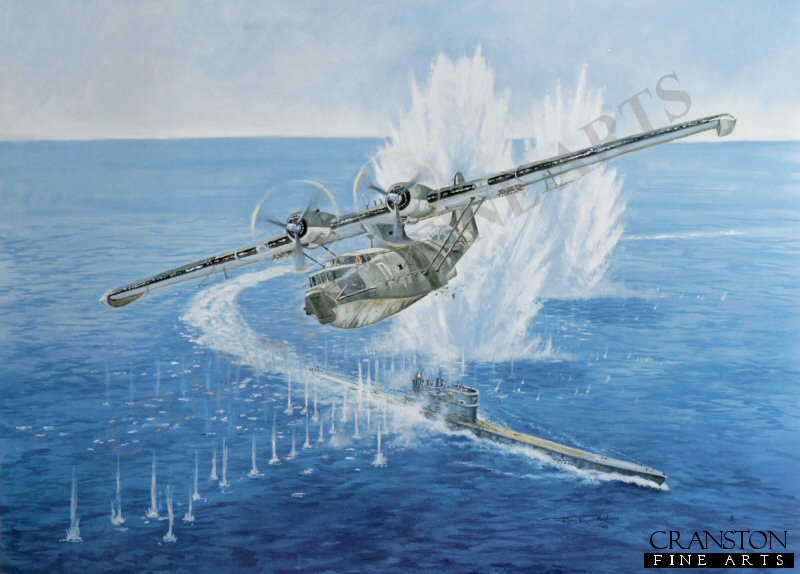
Catalina Attack by John Wynne Hopkins. D for Donald of 270 squadron, Royal Air Force, out of Freetown, West Africa operating in the Atlantic Ocean. It was during routine operation search that D for Donald surprised U515 on the surface and immediately attacked the submarine. U515 in putting up stiff resistance blew a large hole in the hull of D for Donald and the magazine of the starboard side 0.5 twin Browning was hit and the subsequent shrapnel wounded both blister gunners. U515 escaped but was sunk by an American naval hunter group a year later. D for Donald limped back to base and managed to make the beach before it would sink completely. |
Dawn Departure by Ivan Berryman. A Type VIIC U-Boat slips quietly toward the open sea from her pen at Lorient, France in 1942. |
U-203 Under Cover of Darkness by Anthony Saunders. October 1941, U203 approaches her mooring on the western bank at the French port of Brest. Her fate would be sealed by depth charges from the destroyer HMS Pathfinder and aircraft from the escort carrier HMS Biter while attacking the convoy ONS 4 south of Greenland on April 25th 1943. |
U-453 by Ivan Berryman. The Type VIIC U-Boat U-453 began service in June 1941 under the command of Knight's Cross winner Egon-Reiner von Schlippenbach and claimed 10 vessels sunk including the Royal Navy minesweeper HMS Hebe. U-453 was sunk on 21st May 1944 by the destroyers HMS Tenacious, HMS Termagant and HMS Liddesdale off the coast of Italy. She is shown here on one of 17 patrols defending herself from air attack by a Catalina from RAF Coastal Command. |
Dawn Rendezvous by Anthony Saunders. Germanys U-boat fleet had almost brought Britain to its knees in the First World war, twenty years later the story was very similar. the German U-boat arm came perilously close to cutting the lifeline that crossed the Atlantic between North America and Britain. in the early years of the war Donitz realised that keeping his U-boats at sea for as long as possible would greatly increase their chances of success. here U-93 (left) and U-94 take fuel from the auxiliary cruiser Kormoran whilst in the mid-Atlantic during 1941 |
U-552 A Lonely Vigil by Robert Barbour. U-552 heads for home on the surface at sunset in the Atlantic- Summer 1943. |
Wolves at Saint Nazaire by Anthony Saunders. Portrayed in the southern lock at the French port of Saint Nazaire during the Autumn of 1941 are from left: U552, commanded by Kapitanleutnant Erich Topp, U567, commanded by Oberleutnant zur See Engelbert Endrass and U93, commanded by Oberleutnant zur See Horst Elfe. Saint Nazaire was home for two U-boat flotillas: 7. U-Flotille, the Wegener Flotilla and 6.U-Flotille, the Hundius Flotilla. It produced some of the top U-boat commanders including Topp, Endrass, Prien and Kretschmer. The base reached a peak of activity in mid 1943, however, by the end of the war the entire port had been flattened by the allied air forces. The only buildings to survive the onslaught were the bomb proof U-bunkers which can still be seen to this day. |
Surprise Attack by Ivan Berryman. The German crew of a Type VII U-boat man the guns as their submarine comes under a surprise attack from a Beaufighter of Coastal Command. |
U-47 by Ivan Berryman. Under the command of Günther Prien, the deadly U-47 became the 10th most successful U-Boat of World War Two in terms of tonnage sunk. However, on 8th October 1939 she sank the British battleship HMS Royak Oak within Scapa Flow, the main British naval base of the war, despite the anti-submarine measures in place. The submarine was presumed lost with all hands when she failed to return from her 10th patrol in March 1941, although no definitive explanation for her loss exists. |
Erich Topp - U-Boat Commander by Jason Askew. (P) A U-Boat is attacked on the surface by a Beaufighter. A portrait of Erich Topp accompanies this scene. |
Operation Drumbeat by Anthony Saunders. The entry of the United States into the war opened up vast new hunting grounds for the German u-boat fleet. Operation Paukenschlag (Drumbeat in English) began in January 1942, bringing the U-boats their easiest pickings of the war. Over 300 allied vessels were sunk during the Paukenschlag along the US coastline, ranging from New York harbor, to the Straits of Florida. This period, also known as the second Happy Times to the men of the U-boats, was only brought to an end in mid 1942 by the formation of allied convoy systems. On the evening of April 5th 1942, U552, commanded by Kapitanleutnant Erich Topp, sealed the fate of the British tanker MV British Splendour east of Cape Hatteras. The U-boat was part of the fourth wave of boats of Operation Paukenschlag, she returned to Saint Nazaire on April 27th 1942 having sunk seven ships during the patrol. |
Hudson Attack by Marii Chernev. On October 5th 1942 Lockheed Hudson N of 269 Squadron encountered and sank U-619 which was on its first patrol. |
U-997 by Ivan Berryman. A Type VIIC U-boat, U-997 was one of lucky ones to survive the war. One of around 700 of the Type VIIs - the workhorse of the German U-boat threat - it was an example of the 91 Type VIIC/41 variety, one of which is the only surviving Type VII in existence (U-995 is a memorial in Germany). U-997 served between September 1943 and the end of the war when the submarine was surrendered and subsequently sunk by Allied aircraft with more than 100 other U-boats during Operation Deadlight, north-west of Ireland. |
Lone Wolf by Ivan Berryman. The Type VII U-Boat became the standard design for German submarine warfare during the Second World War, sometimes hunting in packs, but more often alone. This Type VIIC has just claimed another victim, surfacing under the cover of night to observe the fiery demise of another victim. |
Tribute to the U-Boat Commanders by Jason Askew. (P) A U-Boat is shown under attack from depth charges. The portrait shows U-Boat commander Erich Topp with the Swordfish emblem of the 11th Flotilla. |
U-552 by Ivan Berryman. Erich Topps notorious Red Devil Boat, U-552, slips quietly away from the scene of another victory in the North Atlantic in 1941. |
Otto Kretschmer - U-Boat Commander by Jason Askew. (P) Notable U-Boat commander Otto Kretschmer is pictured with his U-Boat and the Swordfish emblem of the 11th Flotilla. |
Time to Go by Robert Barbour. A type VIIC U-boat of the German navys 6th-7th Flotilla slowly manouevres within the confines of the Saint Nazaire submarine pens. The type VIIC was armed with 4 torpedo tubes in the bow and one in the stern, and had a range of patrol of approximately 9,700 nautical miles. |
|
Contact Details |
|
Sign Up To Our Newsletter!
This website is owned by Cranston Fine Arts. Torwood House, Torwoodhill Road, Rhu, Helensburgh, Scotland, G848LE Contact: Tel: (+44) (0) 1436 820269. Email: cranstonorders -at- outlook.com
|
|
|