|
|
|
|
|
 |
|
|
|
|
|
|
|
|
Cranston Fine Arts  Landscape Art Countries England Cities Landscape Art Countries England Cities  London London |
| Navigation | |
| Page 1 of 5 | Page 1 .. Next |
| London Landscape Art Prints, Paintings and Drawings |
|
|
|
|
|
|
|
|
|
|
|
|
|
|
|
|
|
|
|
|
|
| Navigation | |
| Page 1 of 5 | Page 1 .. Next |
| Text for the above items : |
St Pauls Cathedral and the City of London by George Chambers (GL) No text for this item |
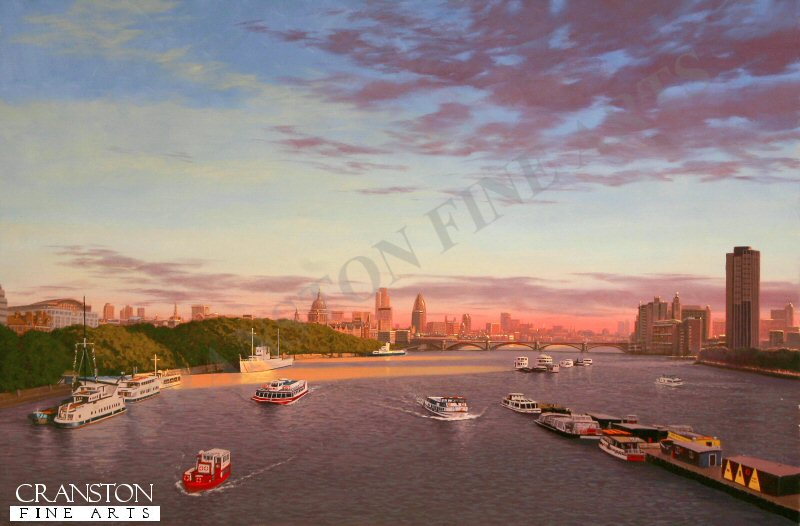
View from Waterloo Bridge by Graeme Lothian. (GS) No text for this item |
Covent Garden by Graeme Lothian. (GS) No text for this item |
Trooping the Colour (1st Battalion Irish Guards) by Graeme Lothian. (GS) No text for this item |
Bristol Bulldogs by Michael Turner. 19 Sqn aircraft performing at the 1934 Hendon Air Display. |
La Belle Sauvage Inn, Ludgate Hill, London by John Charles Maggs. (GL) No text for this item |
Trafalgar Square by Graeme Lothian. (GS) No text for this item |
Departure from Paddington by Terence Cuneo No text for this item |
St James Palace by Graeme Lothian. (GS) No text for this item |
Take it to the Bridge by Ivan Berryman. As cuts to the RAF and other armed services by the Labour Government were implemented in the late 1960s, Flt Lt Alan R Pollock of No.1 Sqn took it upon himself to stage a very personal protest whilst en route to West Raynham from Tangmere on 5th April 1968. Peeling away from the rest of his flight immediately after take off, Pollock flew low-level to London where he buzzed the Houses of Parliament three times before flying his Hawker Hunter FGA.9 under the upper spans of Tower Bridge. The incident is now part of British aviation folklore, but Pollock was immediately removed from flying duties for his audacity. He will always be recorded in history, however, as the first pilot to fly a jet aircraft through Tower Bridge. |
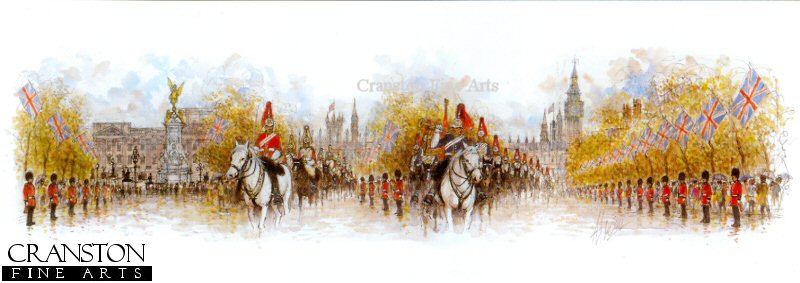
London Pageantry I by Alex Jawdokimov. Depicting Royal Horse Guards, Life Guards and Infantry of the Guard on state occasions. |
The Hand and Shears, Smithfield, London by John Charles Maggs. (GL) No text for this item |
The Embankment from Somerset House by John OConnor. No text for this item |
Buckingham Palace by Graeme Lothian. (GS) No text for this item |
Final Touchdown by Ivan Berryman. The end of an era. British Airways Concorde G-BOAG moments before touching down at Heathrow for the very last time. |
The First Battle of Britain by Stan Stokes. By the Spring of 1917 the Western Front had been stalemated for more than two years with the armies of Germany and the Allies deadlocked in static trench warfare. At sea, the fleets of both Germany and Great Britain were also at a strategic impasse following the inconclusive Battle of Jutland in 1916. The unrestricted U-Boat campaign in the Atlantic had resulted in Americas entry into the War, and Germany turned to its fledgling air force to help break the deadlock. Night raids by Zeppelins in 1915 and 1916 had proven ineffectual as the great airships had proven vulnerable to the unpredictable weather and to increasingly effective defenses. A new strategic weapon would therefore be utilized - the heavy bomber. With a fleet of such airoplanes, the very heart of London could be attacked. In March of 1917 a new unit was formed in Flanders, soon to be known as the England Geschwader. Lead by Hauptman Ernst Brandenburg, Kaghol 3 (the units official designation,) was equipped with the Gotha G. IV. With a crew of three, and a wingspan of nearly seventy-eight feet, the G. IV was an impressive flying machine. Powered by twin 260-HP Mercedes six cylinder, in-line, water-cooled engines, the Gotha had a top speed of 88-MPH. Its service ceiling was more than 21,000 feet, and its range was 305 miles. The maximum bomb load was 1,100 pounds, but on the first daylight raid on London, each aircraft would carry six 110-lb bombs. For defensive purposes the Gothas were armed with two 7.92mm machine guns. An interesting feature of the G. IV was the ability of the rear gunner to fire not only rearwards and upwards, but could also fire downwards through a specially designed tunnel in the fuselage. On June 13, 1917 Brandenburg led his unit in his red-tailed Gotha on the first daylight bombing raid to London. Twenty G. Ivs departed on this historic mission, but two soon turned back, and another four bombed other targets due to mechanical problems. A total of 128 bombs were dropped on the mission with devastating effects. All told, 162 people were killed in the raid, and another 432 were injured. It was a portent of the future of aerial warfare. Although 94 defensive sorties were flown against the raiders, only a few British fighters made contact with the Gothas before they reached their targets. One fighter which did intercept was a Bristol F2B piloted by Capt. C. W. E. Cole-Hamilton of No. 35 Training Sqaudron. The observer, Capt. C. H. Keevil was killed during the battle. After the safe return of all the Gothas, Brandenburg was personally decorated with the Pour le Merite. Unfortunately, he was seriously injured in a flying accident only six days later. By then the first battle of Britain was well underway. |
Kew Gardens by Graeme Lothian. (GS) No text for this item |
Concorde - Early Morning Arrival by Stephen Brown. The sight of Concorde descending over London will forever remain etched in the memory of all who were fortunate to see this amazing aircraft. At Mach 2 Concorde could fly at 23 miles a minute - one mile every 2.5 seconds. A truly astonishing aircraft and one which to this day is sadly missed by its regular passengers and millions of admirers all over the world. |
The Cock and Magpie, Drury lane, London by John Charles Maggs. (GL) No text for this item |
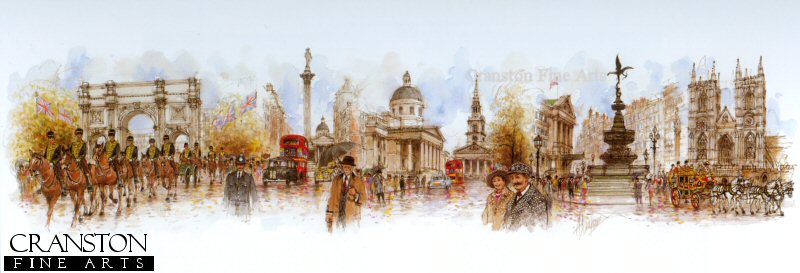
London Pageantry II by Alex Jawdokimov. London scene showing the Kings Troop in ceremonial dress. State occasion at Westminster Abbey, and other famous London buildings Nelsons Column, St Pauls. |
Westminster Bridge by Claude T Stanfield Moore. (GL) No text for this item |
|
Contact Details |
|
Sign Up To Our Newsletter!
This website is owned by Cranston Fine Arts. Torwood House, Torwoodhill Road, Rhu, Helensburgh, Scotland, G848LE Contact: Tel: (+44) (0) 1436 820269. Email: cranstonorders -at- outlook.com
|
|
|