|
|
|
|
|
 |
|
|
|
|
|
|
|
|
Cranston Fine Arts  Special Offers Buy One Get One Half Price  Military Art |
[UP] - Military Art - Aviation Art - Naval Art - Sport Art |
| More Pages : Napoleonic Era - World War Two - World War One - Zulu Wars - Crimean War - Ancient Era - Medieval Era - English Civil War - US History - Modern Era |
| Navigation | |
| Page 1 of 180 | Page 1 .. Next |
|
|
|
|
|
|
|
|
|
|
|
|
|
|
|
|
|
|
|
|
|
| Navigation | |
| Page 1 of 180 | Page 1 .. Next |
| Text for the above items : |
Rearguard at Dunkirk by David Pentland. (AP) Northern France, 1st June 1940. Beleaguered troops of the BEF, fight a delaying action against the German encirclement of the doomed town. |
Stragglers of the 66th (Berkshires) Coming In by Harry Payne. No text for this item |
EOD Bomb Disposal Engineers by Graeme Lothian. (GL) An EOD team move down a track in Helmand Province - watched by curious locals. The lead elements carrying a 'Vallon' (IED mine detector) and a dog handler will go out in front of the main command soldiers. If detected, the personnel seen in the rear of the group will make safe the IED and the process can begin again. |
Royal Engineers - Bridge Building at PB SPARTA by Graeme Lothian. (B) No text for this item |
The Battle of Teutoburg Forest, AD 9 by Brian Palmer. (B) In AD 9, three Roman legions - 20,000 men plus camp followers - commanded by Governor Varus crossed the Rhine into what they believed to be friendly territory on their way to putting down a local uprising. A young chieftain of the Cherusci tribe, Arminius, had guaranteed them safe passage through his lands. However, Arminius who held a grudge against the Romans, deliberately deceived Varus and in a four-day running battle in the forest overwhelmed and slaughtered the Romans almost to a man. Varus, along with his surviving senior officers, took their own lives to avoid capture. |
Earps Vendetta by Bud Bradshaw. (AP) Wyatt, Doc Holliday, and the rest of the Earp entourage ride to carry out their vendetta against the cowboy gang. The dramatic finale to one of the American Wests most violent chapters, Earps Vendetta Ride earned Wyatt more notoriety in the eyes of his contemporaries than did his role at the OK corral. |
Hamminkeln, 6th Airborne Assault over the Rhine, 24th March 1945 by John Sellers. No text for this item |
The Battle of Waterloo by David Rowlands. (AP) The Royal Artillery in Action on 18th June 1815. |
Chindits landing at Broadway, Burma, 5th / 6th March 1944 by David Rowlands (AP) No text for this item |
Motorcycle Attack by David Pentland. (AP) May 1940. At the forefront of the German panzer divisions and leading the advances into France were the Kradschutzen Truppen or motorcycle troops. Although mainly acting in the reconnaissance role they also had the firepower to hold objectives until reinforced. |
Private, 1st or Kings Dragoons Guards by J C Stadler after Charles Hamilton Smith. Modern reprint of the coloured lithograph vignettes by J C Stadler after Charles Hamilton Smith from Charles Hamilton Smiths Costumes of the Army of the British Empire, according to the last regulations 1812, published by Colnaghi & Co. 1812-1815, showing the British uniform of 1812 during the Napoleonic war. Only 800 have been reprinted in 2002. |
Returning to Quarters After a Field Day by Harry Payne. 12th Lancers uniform 1890s. |
67 Works Group Royal Engineers by Graeme Lothian. (APB) Delivers infrastructure engineering support, civil, electrical and mechanical engineering consultancy. This painting shows the team taking soil samples with a view to building a bridge across a wadi. On the far side of the bank soldiers can be seen in consultation with the elders from the local village. Force protection gives cover while all this is going on. |
Waterloo, 18th June 1815 - Charge of the 6th (Inniskilling) Dragoons by Brian Palmer. (AP) To the cheers of Vive L'Empereur 17,000 men of d'Erlon's Corps advanced on the allied left centre in an attempt to break Wellington's line that was already shaken by a massive artillery bombardment. To counter this threat, Wellington launched his heavy cavalry. Forming the centre of the Union Brigade, so called from the composition of English, Irish and Scottish regiments, the Inniskillings charged through the allied infantry and artillery straight to d'Erlon's advancing coloumns inflicting serious casualties and taking many prisoners. Despite appalling losses, the heavy cavalry had gained a welcome respite for Wellington's hard pressed infantry. |
Thunder in the Valley by David Pentland. (GS) FOB Shank, Logar Province, Afghanistan, July 2012. U.S. Army paratroopers of A Battery, 4th Battalion, 319th Airborne Field Artillery Regiment, 173rd Airborne Brigade Combat Team fire a M777A2 155mm howitzer on Taliban positions. |
The Battle of Bannockburn by Brian Palmer (GS) Robert the Bruces Scots army stand fast as the English knights attack. Robert the Bruce succeeds in defeating the English army at Stirling. With the full might of Englands army gathered before the besieged Stirling Castle, Edward II Plantagenate is confident of victory. To the west of Bannockburn, Robert Bruce, King of Scots, kneels to pray with his men and commends his soul to God. Patiently awaiting the coming onslaught in tightly packed schiltroms, his spearmen and archers are well prepared for battle. Unknown to the English, the open marsh of no mans land conceals hidden pits and calthrops, major obstacles for any mounted charge. Despite Cliffords and Beaumonts premature and unsuccessful attempt to relieve Stirling the day before, years of victory have caused the brave English knights to regard their Scottish foes with contempt. So, without waiting for the flower of the forest (archers) to weaken the enemy formations, the order is hurriedly given to attack! With one rush, hundreds of mounted knights led by the impetuous Earl of Gloucester, thunder headlong through the boggy ground straight for the impenetrable mass of spears, hurling themselves into defeat and death. With dash and courage the knights try to force a way through but the infantry stand firm. There is no room to manoeuvre. Everywhere horses and men crash to the ground. Casualties amongst the English nobility are horrific. Bruce seizes the moment and orders the exultant army to advance. The English recoil and are pushed back into the waters of the Bannockburn where many perish in the crush to escape the deadly melee. Edward II, his army destroyed, flees with his bodyguard for the safety of the castle but is refused refuge and has to fight his way south to England. For Robert Bruce and Scotland, victory is complete. |
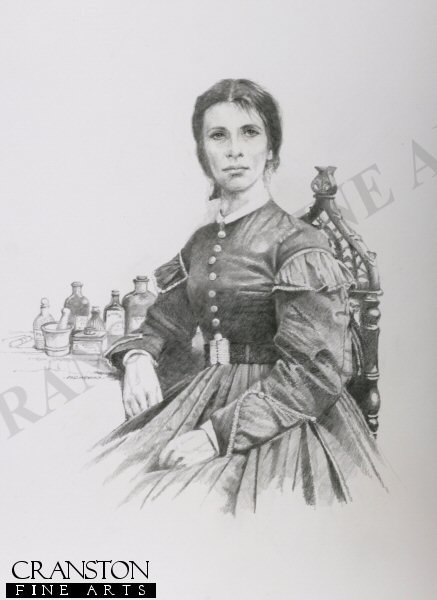
A Mother of the American Civil War by Chris Collingwood (P) No text for this item |
Defence of Rorkes Drift by Alphonse De Neuville. (B) By about 6pm the Zulu attacks had extended all around the front of the post, and fighting raged at hand-to-hand along the mealie-bag wall. Lieutenant Chard himself took up a position on the barricade, firing over the mealie-bags with a Martini-Henry, whilst Lieutenant Bromhead directed any spare men to plug the gaps in the line. The men in the yard and on the front wall were dangerously exposed to the fire of Zulu marksmen posted in the rocky terraces on Shiyane (Oskarsberg) hill behind the post. Several men were hit, including Acting Assistant Commissary Dalton, and Corporal Allen of the 14th. Surgeon Reynolds treated the wounded as best he could despite the fire. Once the veranda at the front of the hospital had been abandoned, the Zulus had mounted a determined attack on the building itself, setting fire to the thatched roof with spears tied with burning grass. The defenders were forced to evacuate the patients room by room, eventually passing them out through a small window into the open yard. Shortly after 6pm Chard decided that the Zulu pressure was too great, and ordered a withdrawal to a barricade of biscuit boxes which had been hastily erected across the yard, from the corner of the store-house to the front mealie-bag wall. In this small compound the garrison would fight for their lives throughout most of the coming night. |
Mobility Troop Re-Supply by Stuart Brown. A heavily armed SAS fighting column is re-supplied by a Royal Air Force Chinook of 7 Sqn. Re-supplies such as these, often performed under the cover of darkness, allow Special Forces to operate deep behind enemy lines for months at a time where necessary. |
Crossing the North Rumaylah Bridge, Iraq. by David Rowlands (AP) 25th-26th March 2003. 3rd Battalion The Parachute Regiment Battle Group. Operation TELIC. |
Confederate Bugler by Chris Collingwood (AP) No text for this item |
|
Contact Details |
|
Sign Up To Our Newsletter!
This website is owned by Cranston Fine Arts. Torwood House, Torwoodhill Road, Rhu, Helensburgh, Scotland, G848LE Contact: Tel: (+44) (0) 1436 820269. Email: cranstonorders -at- outlook.com
|
|
|