|
|
|
|
|
 |
|
|
|
|
|
|
|
|
Cranston Fine Arts  Special Offers Buy One Get One Half Price Military Art  Medieval Era |
[UP] - Napoleonic Era - World War Two - World War One - Zulu Wars - Crimean War - Ancient Era - Medieval Era - English Civil War - US History - Modern Era |
At least one edition of each of the items on this page is available in the offer. Click through to the product page to see all the edition details.
| Navigation | |
| Page 1 of 5 | Page 1 .. Next |
|
|
|
|
|
|
|
|
|
|
|
|
|
|
|
|
|
|
|
|
|
| Navigation | |
| Page 1 of 5 | Page 1 .. Next |
| Text for the above items : |
The Black Prince Before the Battle of Crecy by Mark Churms. Battle of Crecy. One of the battles fought during the Hundred Years War, on 26th August 1346. On 12th July Edward III landed in Normandy with his army and marching north plundered the countryside. King Philip VI assembled an army to stop Edward and tracked them across the Somme River. When Edward reached Crecy he stopped and ordered his army to take up defensive positions. King Philip surveyed the English positions and decided to postpone his attack until August 27th. However, the French vanguard pressed forward too far and so committed the entire army to the battle. The hired Genoese crossbowmen began the assault but came under severe attack from the English longbows and so fled to the rear. King Philip then ordered his cavalry to charge resulting in a huge loss of horse and man under the barrage of arrows which rained down on them. By the end of the night after several unsuccessful assaults the French army was reduced by a third and King John of Luxemburg was dead. Edward then turned towards Calais. |
Battle of Hastings by Tom Lovell. Stand Fast! Stand Fast! shouts Bishop Odo,.. Fear nothing, for if God please, we shall conquer yet. So they took courage, - wrote 12th century chronicler Master Wace. - He...sat on a white horse, so that all might recognize him. In his hand he held a mace, and wherever he saw most need he...Stationed the knights, and often urged them on to assault...the enemy. |
After the Battle by Sir William Allen. Robert the Bruce, the victor of Bannockburn is shown asleep with sword in hand in one of the smaller historical paintings by Sir William Allen. |
William the Conqueror at the Battle of Hastings by Matania. William the Conqueror feigned a withdrawal of his cavalry, the Saxon infantry again could not resist to break ranks and pursue the cavalry. Halfway down the hill Williams knights turned and charged the Saxon infantry. King Harold at this time was mortally wounded from an arrow in the eye and the victory was won by the Normans. Each side lost a quarter of their men and during the fighting William the Conqueror had three horses killed under him. Later he ordered the building of Battle Abbey on the battlefield. The way was clear to London and William the Conqueror was crowned King of England on Christmas day at Westminster Abbey. |
Edward II at the Battle of Bannockburn by Jason Askew. King Edward the 2nd on the field at Bannockburn with his body guard near. He would later leave the battle in his escape as the battle was lost to Robert the Bruce. |
The Joust of Peace (The Black Knight) by Mark Churms. Edward Plantagenet, Prince of Wales turns his charger once more to engage his opponent in a joust of courtesy using blunt lances. |
The Battle of Stirling Bridge by Brian Palmer. After Edward 1st proclaimed himself King of Scotland Sir William Wallace rallied Scots in the South West and began attacking English occupying forces around Scotland. Edward I ordered the Earl of Surrey to put down the rebellion, after taking the surrender of rebel forces at Irvine the Earl of Surrey marched against William Wallaces forces at Stirling. He ordered his army to cross the narrow bridge over the Forth River near the Abbey of Cambuskenneth on September 11th. From a vantage point overlooking the bridge William Wallace watched and waited until the English army of 5,000 had crossed Stirling bridge and with the bridge being crowded with troops he launched his attack with his entire force wiping out the entire bridgehead. The rest of the English army fell back but William Wallace pursued. After this defeat English forces were evacuated south as far as the River Tweed. |
Battle of Crecy by Brian Palmer. Battle of Crecy 26th August 1346. On 12th July Edward III landed in Normandy with his army and marching north plundered the countryside. King Philip VI assembled an army to stop Edward and tracked them across the Somme River. When Edward reached Crecy he stopped and ordered his army to take up defensive positions. King Philip surveyed the English positions and decided to postpone his attack until August 27th. However, the French vanguard pressed forward too far and so committed the entire army to the battle. The hired Genoese crossbowmen began the assault but came under severe attack from the English longbows and so fled to the rear. King Philip then ordered his cavalry to charge resulting in a huge loss of horse and man under the barrage of arrows which rained down on them. By the end of the night after several unsuccessful assaults the French army was reduced by a third and King John of Luxemburg was dead. Edward then turned towards Calais. |
Battle of Hastings by Brian Palmer. The Battle of Hastings: While King Harold II was defeating the Norse invasion at the battle of Stamford Bridge in the north, the Norman invasion led by the Norman Duke William landed in the south. A Norman force of 7,000 warriors sailed across the English Channel in 450 flat boats and landed at Pevensey in Sussex on September 28th. The following two weeks saw the Norman army organising and raiding the local area for supplies. On hearing of the invasion, King Harold marched south from York to London, a distance of 200 miles, in seven days. And on October 13th with his army of 7,000 men took up position on Senlac Hill, 8 miles north of Hastings. Harold took this position as this was the direct route for London. The following day, the Normans attacked the village (which is now the town of Battle). The Battle of Hastings was a battle between King Harolds infantry and the Norman cavalry and archers. The Saxon line threw back the first charge of Norman knights and as the knights began retiring, the Saxons began to pursue the cavalry but a counter attack by Williams disciplined knights cut down the Saxon infantry. King Harold reformed his line before the second Norman cavalry attack was launched. For many hours King Harolds Saxon infantry held their ground against the repeated cavalry charges, both sides suffered heavy losses. As the evening progressed the battle turned the Normans way, William feigned a withdrawal of his cavalry, the Saxon infantry again could not resist to break ranks and pursue the cavalry. Halfway down the hill Williams knights turned and charged the Saxon infantry. King Harold at this time was mortally wounded from an arrow in the eye and the victory was won by the Normans. Each side lost a quarter of their men and during the fighting William the Conqueror had three horses killed under him. Later he ordered the building of Battle Abbey on the battlefield. The way was clear to London and William the Conqueror was crowned King of England on Christmas day at Westminster Abbey. |
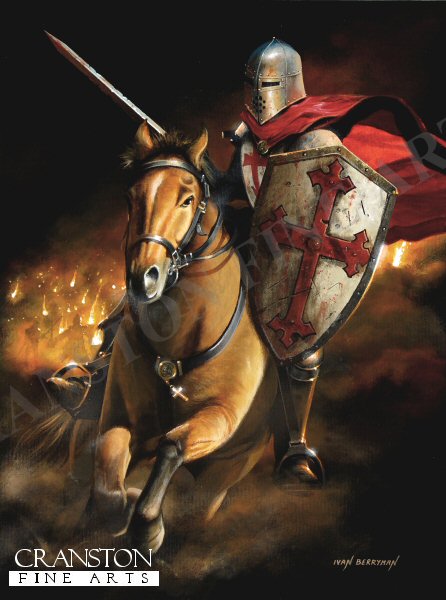
The Blood Red Cross by Ivan Berryman. No text for this item |
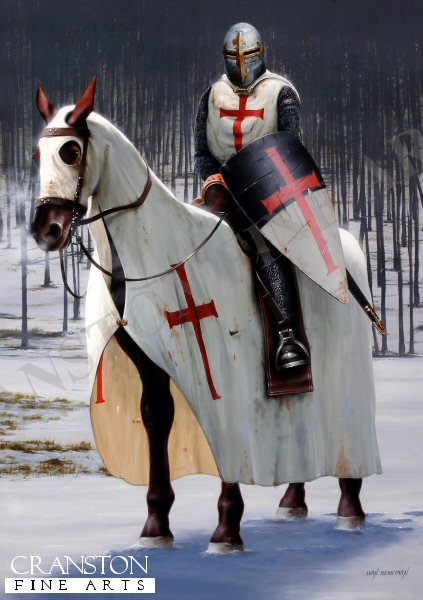
Non Nobis Domine by Ivan Berryman A Knight Templar on horseback, his horse draped in the iconic heraldry of the order. Perhaps one of the most recognisable heraldic symbols of the time, the cross represented martyrdom and courage and was displayed proudly by all members of the Knights Templar. |
Alfred The Great by Chris Collingwood. Alfred was born in 849 at Wantage, Oxfordshire He was the youngest son of King Ethelwulf of Wessex, he became King of the Anglo Saxon Kingdom of Wessex from 871 to 899. Alfred is known for his great defence of the Kingdoms of southern England against the Vikings. Eventually in 871 he made peace with the Vikings who agreed to a withdrawal out of his kingdom. It is likely a large payment of gold was made. Alfred was awarded the epithet The Great, and was the only king to be awarded this title. Alfred the Great was a learned man and improved the education and legal and military systems and structure. Alfred died on the 26th October 899 |
Battle of Nagashino by Brian Palmer. When Portuguese traders took advantage of the constant violence in Japan to sell the Japanese their first firearms, one of the quickest to take advantage of this new technology was the powerful daimyo Oda Nobunaga. In 1575 the impetuous Takeda Katsuyori lay siege to Nagashino castle, a possession of an ally of Nobunagas, Tokugawa Ieyasu. An army was despatched to relieve the siege by Nobunaga and Ieyasu, two of the most influential figures in Japanese history, and the two sides faced each other across the plain of Shidarahara. The Takeda samurai were brave, loyal and renowned for their cavalry charges, but Nobunaga, counting on Katsuyoris impetuosity, had 3,000 musketeers waiting behind prepared defences for their assault. The outcome of this clash of tactics and technologies was to change the face of Japanese warfare forever. |
Richard the Lionheart by Brian Palmer. Richard the Lionhearts tactical skills and military training played a substantial role in the capture of Acre in 1191 by the Crusaders. But Richard the Lionheart was ruthless and after the capture of the city he marched 2,700 Muslim soldiers onto the road of Nazareth and in front of the Muslim army positions, had them executed one by one. But Richard the Lionheart was up against a great leader in Saladin and the crusades did not always go his way. After he negotiated the Treaty of Jaffa with Saladin and secured the granting of special rights of travel around Palestine and in Jerusalem for Christian pilgrims, Richard the Lionheart started his journey back to England in 1192. He was shipwrecked, and captured by the German Emperor Henry VI, only being released after a 150,000 mark ransom was paid. This money was raised by taxes in England. |
King Henry V at the Battle of Agincourt by Sir John Gilbert. Battle of Agincourt, October 25th 1415. Fought during the Hundred years war at the end of the English Invasion of 1415. King Henry the V of England, after his conquest of Harfleur marched his army of 1,000 Knights and 5,000 Archers (many of which were Welsh) towards Calais. He marched to Amiens as flooding had affected the river at the Somme which was the direct route. This delay helped the French army of 20,000 strong under the command of the Constable Charles dAlbret and Marshal Jean Bouciquaut II. The French army blocked Henry V route to Calais, giving the English no choice but to fight. Henry V positioned his army at Agincourt, between to wooded areas giving a frontage of 1100 metres. Henry deployed his force into three divisions; each group had archers at each flank. He had chosen his position well, in front of his army was ploughed fields and due to the heavy raid was very muddy. Due to the narrow battlefield area the French army lost their advantage of superior numbers. At 11 oclock the English started to advance their archers within 2509 yards of the French, getting them into range of the French lines. The French line of Cavalry advanced at a slow pass due to the heavy mud, They took heavy losses from the arrows from the English Long Bowman. They were eventually repulsed by the Archers who as the French cavalry approached changed from using longbows for axes and swords. The French second Cavalry line advanced only to be finally repulsed after hand to hand fighting. The commander Duc dAlencon was killed in the attack. The second charge had failed and many of the French knights were taken prisoner. Believing he had been attacked in the rear Henry V ordered that the prisoners were to be put to death. In fact There was no real rear attack it was French Camp followers plundering the English Camp. The French camp followers were quickly dealt with and the English again prepared itself for the next attack. The third attack never materialized as the sight of so much blood shed and piles of corpses turned the charge into a retreat. The English had won the day with losses less than 1600 compared to the French losses of over 7,000, including the capture of Bouciquaut. Henry V, his way now cleared reached Calais on the 16th November 1415. Agincourt is one of the great battles of military history, and this victory enabled Henry V to return to France in 1417 and conquer all of Normandy. |
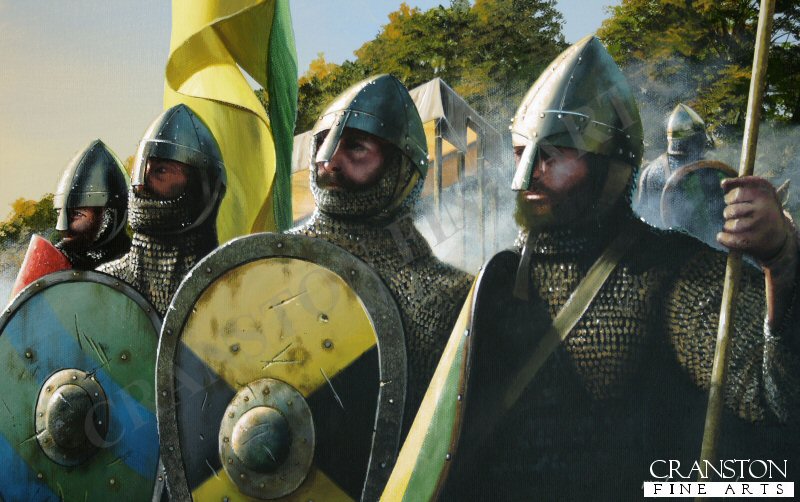
Awaiting Orders by Ivan Berryman. Dawn broke cold over Senlac Hill, Norman soldiers look on across the slope, the English gathered around their king's banner, the golden dragon flying high above a wall of shields. |
Yorkist Soldier by Chris Collingwood. No text for this item |
Richard III by Chris Collingwood. Richard Duke of Gloucester (later Richard III), after the Battle of Tewkesbury, 4th May 1471. Banners are of Richard Duke of Gloucesters White Boar and Sir John Stafford Of Mordaunts (created Earl of Wiltshire by Edward IV) coat of arms. |
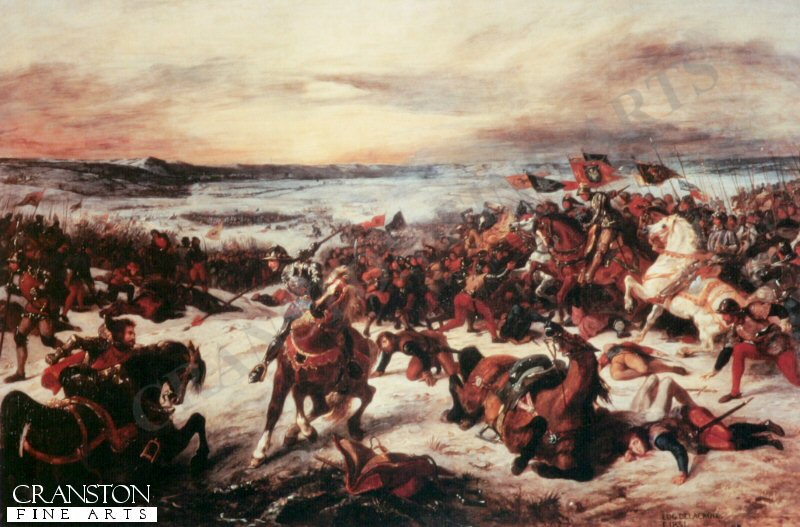
Death of Charles the Brave by Eugene Delecroix. At the battle of Nancy, 1477. Charles the Bold 1433-77. |
A Viking Raid by Brian Palmer. No text for this item |
Heroism and Humanity (Robert the Bruce) by Sir William Allen. Depicting Robert The Bruce with Soldiers and Priest with Women and Children, probably after Bannockburn. |
|
Contact Details |
|
Sign Up To Our Newsletter!
This website is owned by Cranston Fine Arts. Torwood House, Torwoodhill Road, Rhu, Helensburgh, Scotland, G848LE Contact: Tel: (+44) (0) 1436 820269. Email: cranstonorders -at- outlook.com
|
|
|