|
|
|
|
|
 |
|
|
|
|
|
|
|
|
Cranston Fine Arts  Special Offers Buy One Get One Half Price Military Art  Medieval Era |
[UP] - Napoleonic Era - World War Two - World War One - Zulu Wars - Crimean War - Ancient Era - Medieval Era - English Civil War - US History - Modern Era |
At least one edition of each of the items on this page is available in the offer. Click through to the product page to see all the edition details.
| Navigation | |
| Page 2 of 5 | Previous .. Page 2 .. Next |
|
|
|
|
|
|
|
|
|
|
|
|
|
|
|
|
|
|
|
|
|
| Navigation | |
| Page 2 of 5 | Previous .. Page 2 .. Next |
| Text for the above items : |
The Siege of Harfleur, 1415 by Brian Palmer. (GL) King Henry V of England leads his army at the siege of Harfleur in 1415. |
The Battle of Bannockburn by Brian Palmer. Robert the Bruces Scots army stand fast as the English knights attack. Robert the Bruce succeeds in defeating the English army at Stirling. With the full might of Englands army gathered before the besieged Stirling Castle, Edward II Plantagenate is confident of victory. To the west of Bannockburn, Robert Bruce, King of Scots, kneels to pray with his men and commends his soul to God. Patiently awaiting the coming onslaught in tightly packed schiltroms, his spearmen and archers are well prepared for battle. Unknown to the English, the open marsh of no mans land conceals hidden pits and calthrops, major obstacles for any mounted charge. Despite Cliffords and Beaumonts premature and unsuccessful attempt to relieve Stirling the day before, years of victory have caused the brave English knights to regard their Scottish foes with contempt. So, without waiting for the flower of the forest (archers) to weaken the enemy formations, the order is hurriedly given to attack! With one rush, hundreds of mounted knights led by the impetuous Earl of Gloucester, thunder headlong through the boggy ground straight for the impenetrable mass of spears, hurling themselves into defeat and death. With dash and courage the knights try to force a way through but the infantry stand firm. There is no room to manoeuvre. Everywhere horses and men crash to the ground. Casualties amongst the English nobility are horrific. Bruce seizes the moment and orders the exultant army to advance. The English recoil and are pushed back into the waters of the Bannockburn where many perish in the crush to escape the deadly melee. Edward II, his army destroyed, flees with his bodyguard for the safety of the castle but is refused refuge and has to fight his way south to England. For Robert Bruce and Scotland, victory is complete. |
Edward the 1st in Wales by David Pentland. Edward departs from his almost completed Rhuddlan Castle at the conclusion of his second Welsh campaign. |
The Vikings by Brian Wood. This, my personal interpretation of the viking period attempts to highlight aspects of their rich and diverse culture. A superstitious and pagan society, their influence was felt far beyond their native Scandinavia. 1 . The upper background deals with their pagan worship and tales from their mythology. This is represented by Odin & Thor, their principal Gods along with the saga of Sigurd the Dragonslayer. 2. The dominant figure at the centre is Aegir, God of the Sea whose goodwill was all important to the seafaring Viking. The scene now comes into the real world of their ships and seamanship, expertise for which they had no peer. 3. The extension of their seafaring was to raid, trade and pillage foreign shores, resulting in colonisation and settlement, with scant respect for Christianity or the Church. They ventured still further, exploring the unknown world, this is suggested in the two lower corners. 4. In England, the only King to successfully rise up against these Norsemen was Alfred the Great, a Saxon, represented in the lower centre drawing his sword from a swamp. This symbolises the raising of his army from the marshes of Wessex. Their legacy remains with us today, in language and art. |
The Battle of Agincourt by Brian Palmer. The French Knights attack Henry Vs English infantry lines and are repelled during the Battle of Agincourt, a victory for Henry V. |
Richard I (The Lion Heart) During the 3rd Crusade by Chris Collingwood. Richard the Lionhearts tactical skills and military training played a substantial role in the capture of Acre in 1191 by the Crusaders. But Richard the Lionheart was ruthless and after the capture of the city he marched 2,700 Muslim soldiers onto the road of Nazareth and in front of the Muslim army positions, had them executed one by one. But Richard the Lionheart was up against a great leader in Saladin and the crusades did not always go his way. After he negotiated the Treaty of Jaffa with Saladin and secured the granting of special rights of travel around Palestine and in Jerusalem for Christian pilgrims, Richard the Lionheart started his journey back to England in 1192. He was shipwrecked, and captured by the German Emperor Henry VI, only being released after a 150,000 mark ransom was paid. This money was raised by taxes in England. |
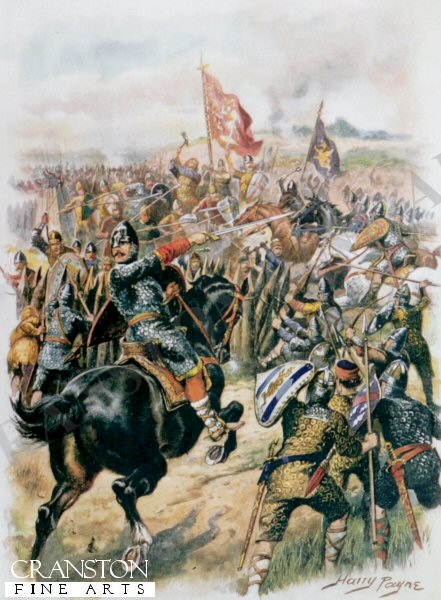
Harold's Last Stand, Battle of Hastings by Harry Payne. William the Conqueror feigned a withdrawal of his cavalry, the Saxon infantry again could not resist to break ranks and pursue the cavalry. Halfway down the hill Williams knights turned and charged the Saxon infantry. King Harold at this time was mortally wounded from an arrow in the eye and the victory was won by the Normans. Each side lost a quarter of their men and during the fighting William the Conqueror had three horses killed under him. Later he ordered the building of Battle Abbey on the battlefield. The way was clear to London and William the Conqueror was crowned King of England on Christmas day at Westminster Abbey. |
Samurai Warriors by Chris Collingwood. Samurai Warriors of the Sekighahara campaign 1600. The most important and decisive battle in the history of Japan, Sekigahara was the culmination of the Power struggle triggered by the death of the great warlord Toyotomi Hideyoshi. The two rivals for power were Ishida Mitsunari and Tokugawa Ieyasu. The contest was ultimately settled by force of arms in a small mountain valley in central Japan. By the end of the day 40,000 heads had been taken and Ieyasu was master of Japan. Within three years the Emperor would grant him the title he sought - Shogun. |
The Homecoming by Ivan Berryman. Professionally produced using a high quality inkjet digital press and printed on 300gsm art stock. |
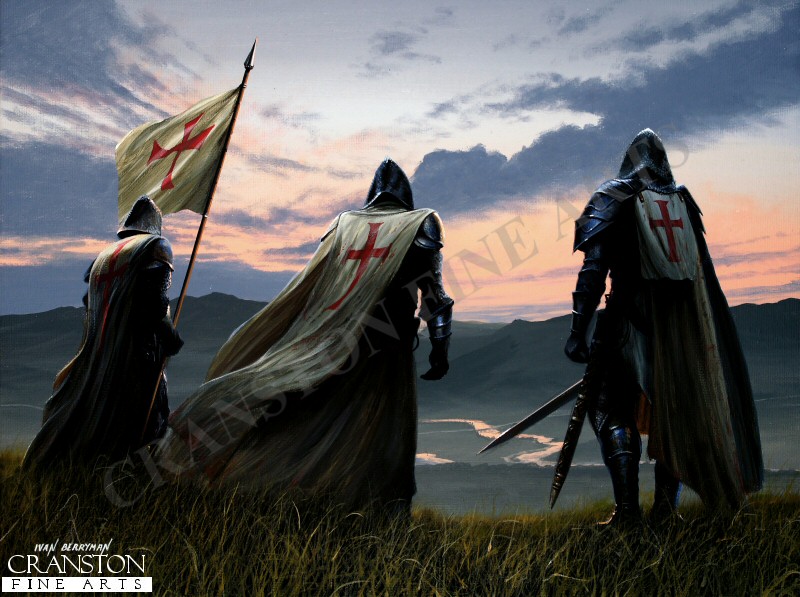
Unholy Land by Ivan Berryman. The Knights Templar, clad in distinctive white mantles adorned with red crosses. These skilled warriors protected Christian pilgrims across the Holy Land and were one of the most powerful military assets during the crusades. |
Robert the Bruce by Jason Askew. Far ahead of Edward II's main army, marching from Falkirk to relieve Stirling Castle, rides the English vanguard. Late on that day, 23rd June 1314, these horsemen advance along the Roman road and cross Bannockburn. Robert the Bruce, King of Scots, rides out ahead of his formations to observe the enemy's advance. One of the English Knights, Sir Henry De Bohun, seeing the King's vulnerable position, gallops ahead of his fellows to engage Bruce in single combat. Undaunted, the King holds his ground. Skillfully turning his mount away from the thrust of the Knights deadly lance in one movement he swings his battle axe down upon his enemy's head with such force that the handle is shattered and the unfortunate attackers skull is split in two. |
Richard the Lionheart by Ivan Berryman. No text for this item |
Sons of Odin by Chris Collingwood. A Viking raiding party comes ashore from their Viking longboat on the western coast of England, 890 A.D. |
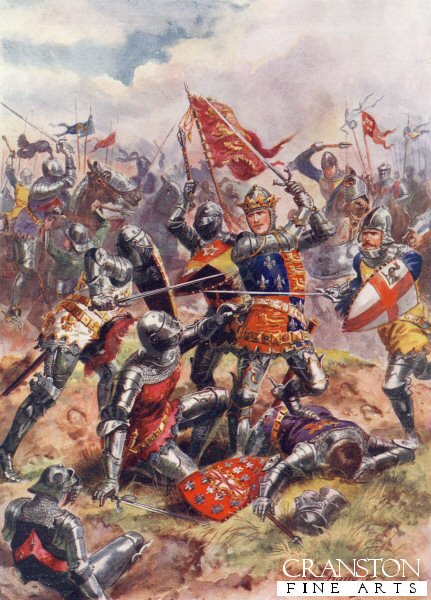
King Henry V Fights With Heroic Valour, Battle of Agincourt by Harry Payne. No text for this item |
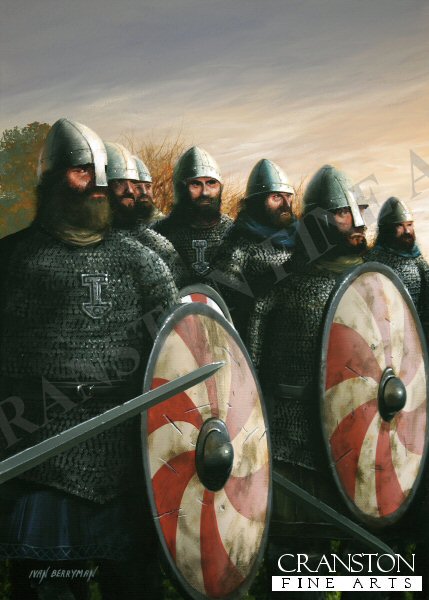
The 14th Dawn by Ivan Berryman. Depicted here at dawn of the battle of Hastings on the 14th of October 1066, the core of King Harold Godwinson's army was made up of housecarls, full-time professional soldiers. Their armour consisted of a conical helmet, a mail hauberk, and a shield. |
The Standard Bearer by Sir John Gilbert. Historical art print of a standard bearer from Henry VIII reign or Queen Elizabeth I reign. |
Battle of Flodden 9th september 1513 by Brian Palmer. While King Henry VIII was invading France, King James IV of Scotland crossed the Tweed into Northern England with a Scots Army of 50,000. With the majority of the English army away in France, the defense of England was left to Thomas Howard Earl of Surrey with an army of 25,000 men. The murderous storm of arrows from the English longbow men cut though he Scottish Schiltrons (dense circles of Spearman). The English cavalry exploited this, cutting through the Scots infantry. this was followed by hand to hand fighting, with the English infantry slaughtering the surviving Scots. At the end of the battle King James IV was dead, along with most of the Scottish nobles. The battle was the last battle to be won by the longbow. |
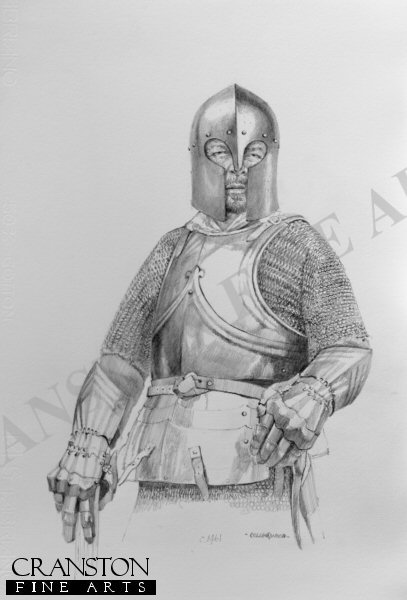
Man at Arms, 1461 by Chris Collingwood (P) No text for this item |
Battle of Stamford Bridge by Brian Palmer. King Harold defeats the Viking invaders at Stamford Bridge before his long march south to face William the Conqueror at the Battle of Hastings. |
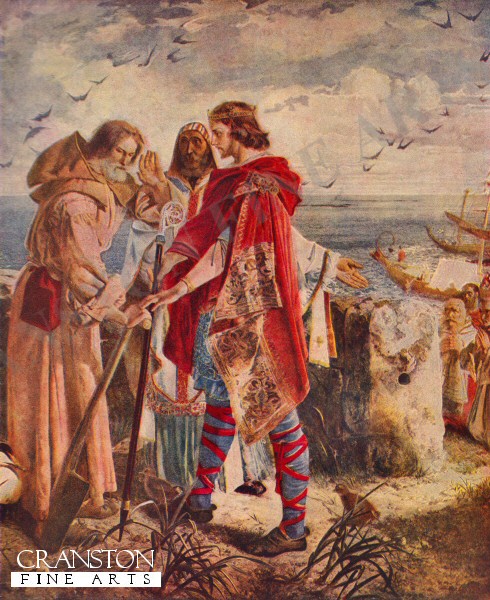
Egfrith Offering The Bishopric of Hexham to Cuthbert, 678 by W. Bell Scott. (B) When Egfrith of Northumbria divided his kingdom into four bishopries. York, Lindisfarne, Hexham and Lindsey and deprived Bishop Wilfred of his power. The see of Hexham was offered to Cuthbert, the hermit of Farne Island. He may have refused the offer, for in 685 he was consecrated Bishop of Lindisfarne but soon after he resigned and returned to his hermitage where he died in 687. |
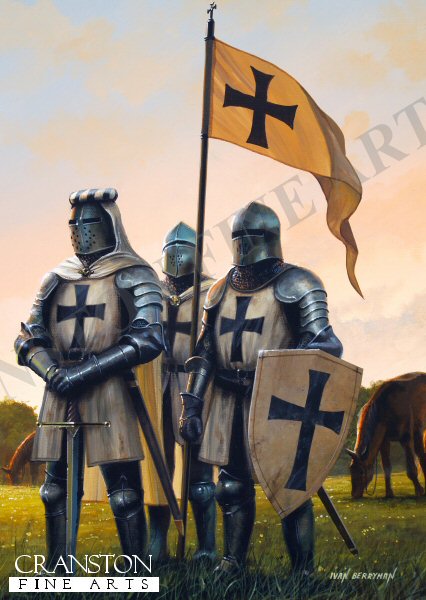
Knights of the Teutonic Order by Ivan Berryman The Knights of the Teutonic Order were a Catholic military order founded around 1190 in Acre. Originally established to aid pilgrims in the Holy Land, the order later became a powerful military force, known for crusades in the Baltic region against pagan peoples, and also for fighting in Eastern Europe. After its initial base in the Holy Land was lost, the order moved to Eastern Europe, building a formidable state in Prussia. |
|
Contact Details |
|
Sign Up To Our Newsletter!
This website is owned by Cranston Fine Arts. Torwood House, Torwoodhill Road, Rhu, Helensburgh, Scotland, G848LE Contact: Tel: (+44) (0) 1436 820269. Email: cranstonorders -at- outlook.com
|
|
|